Correlation Chart

Reveal Hidden Patterns

A Correlation Chart (scatter plot) visualizes relationships between two variables. This quality tool reveals whether changes in one factor affect another—essential for data-driven root cause analysis.

Drowning in data but starving for insights? Correlation charts reveal which problems are actually connected—solve one issue and watch others disappear. This video demonstrates the 5-step correlation analysis process using scatter plots to visualize relationships between variables. Learn the correlation coefficient scale (-1 to +1), see real examples from oven temperature optimization to customer satisfaction analysis, and discover why correlation doesn't equal causation.

You'll learn: How to read scatter plots • The 5-step correlation process • Positive, negative, and no correlation patterns • Critical limitations (causation, outliers, sample size)

[00:00] Introduction: From Data to Insights

Drowning in data but starving for insights. Imagine having a superpower that reveals which problems are actually connected so you can solve one issue and watch others disappear. That's the magic of correlation charts. In the next few minutes, I'll show you how to use them to work smarter, not harder.

[00:17] What Correlation Charts Tell You

In this video, we'll cover what correlation charts really tell you and what they don't. Step-by-step process to create your own correlation analysis. How to use these insights to optimize any business.

A correlation chart reveals how strongly two variables are connected. Think of it as measuring the relationship between two things.

[00:35] Types of Correlation

For example, does more study time lead to better grades? Positive correlation. Does more screen time lead to less sleep? Negative correlation. Or are two things completely unrelated, like the number of times you blink and how good your pizza tastes? No correlation.

[00:55] The Correlation Scale (-1 to +1)

Correlation is measured on a scale from -1 to positive 1 (+1).

+1: Perfect positive correlation. As one variable increases, the other increases in perfect proportion.

-1: Perfect negative correlation. As one variable increases, the other decreases in perfect proportion.

0: No correlation whatsoever.

The closer to +1 or -1, the stronger the relationship. The closer to zero, the weaker it is.

[01:16] The 5-Step Process

But how do you use a correlation chart to optimize your business? Well, here are the basic steps. Don't worry, I'll go through them all using our zero defect pizzeria example.

Step 1: Define your question. The pizzeria manager wants to know, does increasing oven temperature reduce baking time while maintaining quality?

[01:38] Step 2: Collect Your Data

The staff systematically tests different oven temperatures and records the exact time needed to achieve a perfect pizza crust.

[01:57] Step 3: Choose the Right Method

For continuous data like temperature and time, we use the Pearson correlation coefficient. For ranked or ordinal data, the Spearman coefficient works better.

FYI, continuous data represents values within a continuous range, allowing for any value between two points, while ordinal data represents ordered categories where the difference between categories is not necessarily equal.

[02:23] Step 4: Calculate the Coefficient

No complex math needed. Input your data into Excel, Google Sheets, or any statistical software to calculate the correlation coefficient automatically.

[02:23] Step 5: Visualize with Scatter Plots

This is where scatter plots come in. The most powerful way to visualize correlation.

What is a scatter plot? A scatter plot is a graph where each dot represents a pair of values. For our pizzeria, each dot represents one pizza that was baked. The horizontal position (x-axis) shows the oven temperature. The vertical position (y-axis) shows how long it took to bake.

[02:44] Reading Scatter Plots

When you add a trend line (or line of best fit) through these points, you instantly see the relationship pattern. The steeper the slope, the stronger the correlation.

[03:05] Example 1: Temperature vs Baking Time

Let's look at our pizzeria's scatter plot. Each blue dot represents a pizza baked at a specific temperature (x-axis), and how long it took to reach perfect quality (y-axis).

Notice three key elements:

The pattern: As you move right (higher temperature), the dots tend to move down (less baking time).

The trend line: The red dotted line slopes downward, confirming the negative relationship.

The coefficient: -0.87
Very close to -1, indicating a strong negative correlation.

This visualization makes it clear: higher temperatures do significantly reduce baking times while maintaining quality. With this evidence, the pizzeria can confidently increase oven temperatures to reduce production time, serve customers faster, maintain the same quality, and potentially increase daily output.

[03:44] Example 2: Pizza Size vs Satisfaction

The manager also wonders: does pizza size affect customer satisfaction? After surveying customers who ordered different sizes and rating satisfaction on a scale of 1 to 10, looking at this scatter plot:

The pattern: The dots are scattered randomly with no clear direction.

The trend line: Almost horizontal, showing no relationship.

The coefficient: 0.12
Very close to zero, indicating essentially no correlation.

Notice how different this looks from our first example. When there's no correlation, the dots appear randomly distributed with no clear pattern. The trend line is flat and points are scattered above and below it with no consistency.

This insight saves the pizzeria from unnecessarily investing in larger pizza sizes that wouldn't actually improve customer happiness. A data-driven decision that saves both time and money.

[04:28] Critical Warning: Correlation ≠ Causation

Before you run off to correlate everything: Correlation does not equal causation. Just because two things are related doesn't mean one causes the other.

Pizza delivery orders and Netflix streaming both spike on rainy days, but ordering pizza doesn't cause people to watch movies. Staying indoors due to weather influences both behaviors.

[04:46] Important Limitations

External factors: Hidden variables might be influencing both your measures. Pizza delivery times and customer complaints might correlate not because of slow service, but because of a third factor—bad weather affecting both.

Outliers: Extreme values can distort your results. One pizza baked by a new trainee at an unusually high temperature could skew your entire correlation if your sample size is small.

Sample size: Too few data points can lead to misleading conclusions. Testing just five pizzas at different temperatures isn't enough to establish a reliable pattern. You need sufficient data to overcome random variation.

Reading scatter plots correctly means looking for points that seem to fall outside the general pattern. These outliers might represent special cases or measurement errors that could skew your results.

[05:29] Benefits & Applications

Correlation analysis and scatter plots can revolutionize how you:

Identify which factors actually impact product quality. Focus improvement efforts where they'll have the greatest effect. Make data-driven decisions instead of relying on hunches. Optimize processes without wasting resources. Visually communicate complex relationships to stakeholders who might not understand statistics.

How would you use correlation charts and scatter plots in your business or personal life? Let us know in the comments below.

What Is a Correlation Chart?

A Correlation Chart  (also known as a Scatter Plot) hart is a graphical representation of the relationship between two or more variables, and one of the key aspects of this chart is the correlation coefficient, often denoted as “r.”
The correlation coefficient is a numerical measure that quantifies the strength and direction of the linear relationship between the variables being studied.
 
A scatter plot is the most common form of a correlation diagram. In this, data points are displayed as individual points in a Cartesian coordinate system, with each point representing the values of two variables.

The shape of the point cloud can also provide insight into non-linear relationships that the correlation coefficient alone would not capture. The distribution of these points makes it possible to visually recognize patterns and relationships:

  • A tight grouping of points along an imaginary line indicates a strong correlation.
  • The closer the correlation coefficient r is to +1 or -1, the stronger the correlation.
  • When r ≈ 0, there is practically no linear relationship between the variables.
  • The direction of the point cloud shows whether the correlation is positive (ascending) or negative (descending).

Correlation Chart – Real-World Examples

1. Pizza / Food Service

Oven Temperature vs. Customer Satisfaction

Professional correlation analysis example from the food industry demonstrating the relationship between oven temperature and customer satisfaction ratings. Shows optimal temperature range identification using scatter plot analysis, trendline fitting, and R² interpretation for quality optimization.

💡 Want to create your own? Contact me for the free template.

2. Automotive / Manufacturing

Training Hours vs. Defect Rate

Automotive correlation analysis example showing the relationship between operator training hours and production defect rates. Demonstrates strong negative correlation analysis for quality improvement initiatives and workforce development according to IATF 16949 requirements.

💡 Want to create your own? Contact me for the free template.

3. Pharma / Production

Storage Duration vs. Active Ingredient Stability

Pharmaceutical correlation analysis example demonstrating the relationship between storage duration and active ingredient degradation. Critical for GMP compliance, shelf-life determination, and regulatory documentation with statistical validation.

💡 Want to create your own? Contact me for the free template.

4. Service / Customer Support

Wait Time vs. Customer Satisfaction

Service industry correlation analysis example showing the relationship between customer wait time and satisfaction scores. Identifies critical thresholds for service level optimization, resource allocation, and customer experience improvement.

💡 Want to create your own? Contact me for the free template.

5. IT/Software Industry

CPU Utilization vs. Response Time

IT/DevOps correlation analysis example demonstrating the relationship between server CPU load and application response time. Essential for capacity planning, SLA compliance monitoring, and performance optimization with predictive analytics.

💡 Want to create your own? Contact me for the free template.

Why Use Correlation Charts?

Correlation charts focus on unveiling relationships between variables in a measurable and visual sense. They allow making data-driven decisions and forecasting the future from historical data.

When to Use a Correlation Chart

Correlation charts are primarily employed to examine the degree and direction of association between variables. They help identify whether changes in one variable correspond to changes in another, making them indispensable for quality control, research, and decision-making. 

Typical areas of usage include:

Graphic showing correlation chart usage in quality control, healthcare, and predictive modeling around a central scatterplot icon.

1. Quality Control and Manufacturing

In quality management, correlation charts are used to identify factors that affect product defects. For example, a manufacturing company might analyze the correlation between production line speed and product quality to optimize their processes.

They also help in root cause analysis by revealing which variables are most strongly associated with defects, enabling targeted improvements.

2. Predictive Modeling

Correlation charts are important with respect to predictive modeling. Correlations are often leveraged by machine learning models to ensure that a relevant feature (variable) selection takes place during prediction. The correlation is useful for the features selection and to reduce the multicollinearity in regression models.

3. Healthcare and Medicine

For instance, in medical research, correlation maps are employed to check out ties concerning client aging, living things and going down with a health condition. Correlation analysis is commonly used in clinical trials to evaluate the effects of treatment on a number of patient outcome measurements.

Typical areas of usage include in detail:

8D-Report Step D4

In the 8D problem-solving process, Step D4 requires root cause identification. After problem definition (D2) and containment (D3), 5-Why Analysis systematically traces the cause chain. The identified root cause drives corrective actions in D5 and preventive actions in D7.

5-Why identifies a suspected root cause; Correlation Charts VERIFY it. “5-Why says operator training causes defects” → Scatter plot of training hours vs. defect rate proves or disproves the theory. Verification follows hypothesis.

When you need to reduce costs, find what DRIVES them. Correlation Charts link process variables to cost outcomes. “Cycle time vs. unit cost” or “Rework hours vs. batch size” reveals where cost reduction efforts should focus.

The DMAIC Analyze phase requires identifying root causes with data. Correlation Charts are core Analyze tools – they statistically prove which X’s affect Y. No correlation = no causation = eliminate that hypothesis

The DMAIC Analyze phase requires identifying root causes with data. Correlation Charts are core Analyze tools – they statistically prove which X’s affect Y. No correlation = no causation = eliminate that hypothesis

In the PDCA cycle, the Check phase compares results to expectations. When gaps appear, 5-Why Analysis explains why the plan didn’t work – driving adjustments in the Act phase.

Machine parameters (speed, pressure, temperature) affect outputs. Correlation Charts show WHICH parameters matter most. Before adjusting everything, identify the critical few inputs that actually drive quality.

After Ishikawa brainstorming generates potential causes, Correlation Charts TEST them. “We think machine speed causes defects” becomes “r = -0.87 confirms machine speed strongly correlates with defects.”

DOE generates data; Correlation Charts visualize it. Each factor-response pair becomes a scatter plot showing effect strength. Before diving into ANOVA tables, see the relationships graphically.

When quality varies with incoming material, Correlation Charts quantify the relationship. “Supplier A’s material hardness vs. our machining defects” reveals whether material specs actually matter – and by how much.

When you need to find the optimal setting for a process variable, Correlation Charts show the relationship between input and output. “At what temperature do we get maximum yield?” – the scatter plot reveals the sweet spot.

Correlation Chart Principles

Action Management is guided by the laws of:

Graphic showing correlation chart principles: value of r, data types, Pearson and Spearman correlation, linearity checks, monotonicity checks, and the reminder that correlation does not imply causation.

Correlation Coefficients: -1 to 1

R — Correlation coefficients are denoted as r and reside on a scale that ranges from -1 to 1.

An r of -1 means you have a perfect negative correlation — as one thing goes up, the other goes down every time. Conversely, an "r" of 1 signifies a perfect positive correlation in which both variables will increase or decrease together perfectly.

That is to say, when r = 0, there is no linear relationship between them and hence they are independent. This makes the scale an objective and quantifiable measure of the strength of relationship.

This ends up providing organizations the definition of what is broken, or what could be made better resulting in effective planning and execution becoming a necessity — to aim all the efforts towards effective results.ess more efficient and effective.

Correlation Coefficient: depends on Type of Data

You should know to use the appropriate type of correlation coefficient: whether Pearson for continuous and Spearman for ordinal data (e.g. yes/no or ok/nok).

Pearson checks on linearity in data while on the other hand Spearman deals with monotonic relationships in data unlike Pearson. This option makes sure the type of analysis we do matches the nature of data for better results.

Correlation Does Not Imply Causation

A correlation simply states that 2 variables are related, and does not suggest at how these could be causally linked. It still cannot be concluded that one causes the other, as two variables can have a correlation but may not be linked in any way; this could only be a coincidence or influenced by an external factor.

Causation — Must use controlled experiments (may simply investigate the effects of one factor at a time), does this cause that etc. Correlation helps you spot correlations, not causality.

Correlation Chart Principles

1. Collect the data about the interesting variables

The initial part of correlation analysis is getting the data for the variables you want to consider. This means getting data points (observations) for each variable, and that the data are a good representation of what you want it to be; you need high quality data collection in order to interpret the correlations properly with robustness.

2. Use a correlation coefficient based on data type

Choose the correct correlation coefficient for a more accurate result. Use the Pearson correlation coefficient for continuous data and the Spearman coefficient for ordinal (ranked) data. The choice should be chosen as per the property of data to capture relationship effectively.

3. Use statistical software to calculate the correlation coefficient

The correlation coefficient is a result of a mathematical operation and we will typically use statistical software or spreadsheet tools to calculate the final output, Excel for example.

Using these tools helps decrease the time it also can assure that the correlation coefficient is computed correctly. 

4. What is the coefficient of (positive, negative or no) correlation?

Correlation coefficient interpretation is essential to know the relationship between two variables.

A positive coefficient means that there is a positive correlation: as the independent variable increased, the dependent variable tended to also increase. If it has a negative sign, it means that the two variables have a negative correlation: an increase in one variable leads to a decrease of the other.

It is important to note that, a coefficient of 0 indicates no linear correlation between the variables and as such changes in one variable do not systematically coincide with changes in the other.

5. Visualize the Relationship using a Scatter plot

Using a scatterplot to show correlation is an important part of analysis. This type of chart gives a clear visual of how the correlation looks. For a positive correlation, points on the scatterplot usually go up, and for a negative correlation, they go down. If there is no correlation, the points are spread out without a clear pattern. This graphic helps explain how strong the correlation is and its direction, while also showing any outliers or odd data patterns.

How to Combine Correlation Charts with Other Quality Tools

Ishikawa Diagram

Ishikawa generates HYPOTHESES about causes; Correlation Charts TEST them with data. For each suspected cause on the fishbone, collect data and create a scatter plot. Strong correlation = valid cause. Weak correlation = eliminate it.

5-Why drills to root cause through logic; Correlation Charts verify through data. After 5-Why concludes “inadequate training is the root cause,” plot training metrics vs. defects. If r is weak, dig deeper – the real root cause is still hidden.

Control Charts monitor STABILITY; Correlation Charts explain RELATIONSHIPS. When a Control Chart signals out-of-control, use Correlation Charts to find which input variable shifted. “Output went out of control when Input X changed” – correlation finds the culprit.

Pareto identifies the vital few problems; Correlation Charts find what CAUSES them. First, Pareto shows “Defect Type A is 60% of problems.” Then, Correlation Charts reveal “Defect Type A correlates strongly with humidity

Control Charts show variation OVER TIME; Histograms show variation DISTRIBUTION. Use both: the Control Chart asks “Is the process stable?” while the Histogram asks “What shape is the variation?” Together, they give complete variation understanding.

Each strong correlation discovered should trigger an action: Investigate further, optimize the parameter, implement controls. Correlation Charts feed Action Management with data-driven priorities.

PFMEA identifies potential failure modes and causes; Correlation Charts validate which cause-effect relationships are real. High-RPN items with unverified cause-effect links deserve scatter plot validation.

Check Sheets collect the RAW DATA; Correlation Charts analyze it. Design your Check Sheet to capture both variables you want to correlate. Then plot the data. Data collection → Relationship analysis.

Correlation Charts support D4 (Root Cause Analysis) with statistical evidence. “We believe X causes the problem” becomes “r = 0.85 proves X correlates with the problem.” Data-driven 8D is credible 8D.

Histograms show DISTRIBUTION of one variable; Correlation Charts show RELATIONSHIP between two. Use both: Histogram for “What does X look like?” and Scatter Plot for “How does X relate to Y?” Distribution + Relationship = complete understanding.

CAPA requires evidence that corrective actions address true root causes. Correlation Charts provide that evidence. “Before CAPA: r = 0.89. After CAPA: r = 0.12” proves the cause-effect link was broken.

Correlation shows IF a relationship exists; Regression QUANTIFIES it for prediction. First, Correlation Chart confirms r = 0.92. Then, Regression gives you the equation: Y = 2.3X + 15. Correlation → Regression → Prediction.

DOE systematically varies inputs; Correlation Charts visualize factor-response relationships. Each DOE factor becomes an X-axis, response becomes Y-axis. Graphical DOE interpretation starts with scatter plots.

When capability is poor, Correlation Charts help find WHY. Plot input variables against capability metrics. “Which machine setting correlates with higher Cpk?” guides parameter optimization.

Before trusting correlation results, verify measurement systems. Poor measurement capability adds noise that weakens apparent correlations. MSA ensures your scatter plot reflects reality, not measurement error.

Benefits of Correlation Charts

Correlation charts are used to identify variables that affect product defects in quality management

This is quite suitable in quality management and can create correlation charts that show a clear indication of what factors cause more defects per product. This way the quality control team can easily identify where the problems occur and can trace (for example) from relevant production parameters material quality or machine performance to find root causes for defects. Using this information, we can take the necessary targeted interventions needed to optimize processes and in the end reduce defects and secure quality in our products.

Correlation charts help with process optimization — illuminating which of the variables affect the quality of our products. Organizations can reverse engineer quality by identifying the variables most strongly associated with desired quality outcomes, so they may deploy those resources in optimizing performance on these determinants. Since all improvements should be considered with a common frame, it ensures that prioritizations are done through real data and not perception of potential quality impact and this makes operations more efficient and effective.

Correlation charts allow decision-makers to make decisions based on user data. This will help them to achieve both quality and efficiency improvements. Knowledge of the relationships between various process variables enables your managers and executives to make strategic decisions, so that they can get excellent product quality without spending unnecessary resources. This promotes better utilisation of resources and maximised operational performance as a whole, offering long-term advantages to the productivity balance sheet.

Correlation Chart Limitations

Correlation does not prove causation: external factors may affect both variables

Correlation analysis does not imply causation. Just because two variables are strongly correlated with each other does not mean one causes the other.

To advance this point further, there also may be lurking or confounding variables that play a role both as individual and together so can it not only directly affect causation but could make the wrong causal claim. As this is a correlational study, it is important that researchers do not extend their interpretations beyond the correlation level. Such insight needs future research to address any causation.

Correlation results can dramatically be influenced by outliers (extreme values that are very different from the rest of the data) as well. The above-mentioned biases can misrepresent the calculated value of this miracle number, and thus leads to unfounded conclusions. To get around this, you need to do a lot of data cleaning. It is therefore important to correctly identify and manage them (transforming or deleting, if necessary) so that the correlation analysis can show an accurate relationship between variables.

Action management that does work is fully supported by strong leadership and commitment throughout an organization.

When leadership does not provide strong support, programs run the risk of being blocked, directionless or losing traction. Leadership is the key to laying down the vision, explaining why quality improvement is important, and giving you adequate resources and powers to make improvements properly.

This has proven to be true for action management efforts, too. They can lose steam and struggle to reach their target goals without robust support from leadership. Consequently, high-functioning leadership that is not only engaged in but aligned with quality improvement objectives is essential to ensure successful integration for organizations.

Correlation Chart Best Practices

Graphic showing best practices for correlation charts: causative factor analysis, time series analysis, and continuous monitoring around a central scatterplot icon.

Explore causative factors alongside correlation analysis to uncover deeper insights 

Although correlation analysis can help in detecting relationships between variables, it is usually interesting to dig going a bit further exploring potential causal factors. Understanding the roots that generate correlations might be very insightful.

If, for example, employees who train more hours are shown to be more productive, then it might actually be the quality of training programs that tips them off. Beyond this, such understanding will enable more focused interventions and improvements that could have positive ramifications in fields such as quality control or process optimization.

Continuously monitor variables to adapt quality control strategies 

One of the major things in quality management is implementing continuous monitoring of appropriate variables. Through correlation analysis one can observe relationships between factors and defects within products, however these relations may change over time.

Gathering and analyzing data on an ongoing basis is key to ensuring that organizations can adjust their quality control strategies as needed for the circumstances. Processes continue to be honed based on new correlation results until achieving "wow" quality.

Use time series correlation to identify trends and seasonal patterns

The time series correlation analysis is a very effective method to detect trends and seasonal patterns in data. Correlation can be applied to time-stamped data e.g. defect counts over months/years — so you are able to see past sequences that have occurred & think about common variability in advance.

This information allows for improved resource allocation, inventory control and production planning. This is vital in every industry whether manufacturing, retail or anything else, as these kinds of correlations will help the decision-makers to take an well-informed decision for a smoother operation.
Correlation Chart Example: Pizza Production

Example 1: Strong negative relationship

Zero-Defect-Pizza pizzeria wants to know whether an increase in oven temperature does linear increase the time the pizza is baked in order to reach Zero Defect Pizza. Sounds like they are guessing that hotter ovens = faster bake times, but need actual proof.

Objective:

Thus, the pizzeria wants a scatter plot to explain how temperature may be related to cooking time by plotting the oven temp on one axis against bake durations on a y-axis and—to gain some measure of strength in this connection.

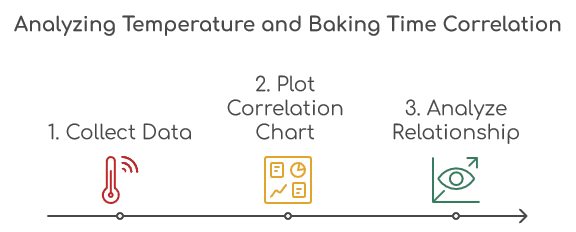
1. Collect Data

To test this, the pizzeria collects data by baking multiple pizzas at different oven temperatures and recording the corresponding baking times required to achieve the desired crust quality.

Here’s the data they collect:

Oven Temperature (°C)Baking Time (minutes)
21014
22013
23012
24011
25010
2609
2708
2807

2. Plot a Correlation Chart

 They plot oven temperature on the X-axis and baking time on the Y-axis to see if there’s a clear relationship:

3. Analyze the Relationship

 The resulting scatter plot will help determine whether the two variables are correlated (e.g., a negative correlation where higher temperatures lead to shorter baking times).

Here the correlation chart is showing the relationship between oven temperature and baking time. The scatter plot represents the data points collected, while the red dashed line shows the trend (best-fit line) indicating the correlation.

Analysis:

    • The chart shows a negative correlation between oven temperature and baking time, meaning as the oven temperature increases, the baking time decreases.
    • This trend supports the pizzeria’s hypothesis that higher temperatures result in shorter baking times.

Example 2: No relationship

Now Zero-Defect Pizza wants to see if there is any correlation between the size of the pizza and customer satisfaction ratings.

They suspect that larger pizzas may lead to higher customer satisfaction, but to confirm this, they collect data by surveying customers who purchase different sizes of pizzas and asking them to rate their satisfaction on a scale of 1 to 10.

1. Data collected

Pizza Size (inches)Customer Satisfaction (1-10 scale)
108
127
149
165
189
106
128
147
169
186

Now our pizzeria data using a scatter plot to see if any clear relationship exists:

2. Analysis

The scatter plot shows that there is no clear relationship between pizza size and customer satisfaction. The data points are scattered without following any consistent pattern, meaning that customer satisfaction does not appear to depend on pizza size in this case.

FAQ Correlation Chart

What is a correlation chart?

A correlation chart is a graphical representation used to visualize the relationship between two or more variables. It helps determine whether a relationship exists, its strength, and its direction (positive, negative, or no correlation). Common examples include scatter plots and heatmaps.

The r-factor, also known as the correlation coefficient (Pearson’s r), is a numerical value that quantifies the strength and direction of a relationship between two variables. It ranges from -1 to +1:

  • +1: Perfect positive correlation (as one variable increases, the other also increases).
  • 0: No correlation (no relationship between the variables).
  • -1: Perfect negative correlation (as one variable increases, the other decreases).

Correlation analysis is performed in various scenarios, such as:

  • Scientific research to explore relationships between variables.
  • Business and finance to analyze trends, such as stock prices and sales performance.
  • Healthcare to study relationships between lifestyle factors and health outcomes.
  • Engineering and manufacturing to examine how process variables interact.

The main principles of correlation analysis include:

  1. Direction of Relationship – Positive, negative, or no correlation.
  2. Strength of Relationship – Measured using the correlation coefficient.
  3. Causation vs. Correlation – Correlation does not imply causation.
  4. Data Reliability – Requires accurate and sufficient data for meaningful results.

A correlation analysis follows these steps:

  1. Collect data on the variables of interest.
  2. Plot the data using a scatter plot or heatmap.
  3. Calculate the correlation coefficient (r) using statistical formulas or software.
  4. Interpret results to determine the strength and significance of the relationship.
  • Provides insights into relationships between variables.
  • Helps in forecasting and prediction of trends.
  • Simplifies complex datasets into visual representations.
  • Guides decision-making by identifying influential factors.
  • Does not establish causation A strong correlation does not mean one variable causes the other.
  • Sensitive to outliers – Extreme values can distort results.
  • Only measures linear relationships – It may not detect non-linear relationships.
  • Requires a sufficient data sample – Small datasets may lead to misleading conclusions.
  • Use an appropriate sample size to avoid bias.
  • Check for outliers and anomalies before drawing conclusions.
  • Combine correlation with other statistical methods for deeper insights.
  • Interpret results cautiously to avoid assuming causation.
  • Use proper visualization tools like scatter plots or heatmaps for clarity.
Table of Contents
    Add a header to begin generating the table of contents
    Newsletter
    social media
    related post

    Have you ever wondered why some problem-solving efforts succeed while others fail? I have seen thousands of 8D reports and......

    “What is quality?” or “What are you exactly doing in quality?”, sometimes people, my family or friends are asking. After......

    “I’d rather clean the toilets in our office building than doing that.” That was my reaction when I was asked......

    RELATED Modules
    Ready to cut Quality Issues, boost Customer Satisfaction, and keep your Team happy?

    Join Zero Defect Pizza and discover powerful tools, proven methods, and expert insights to minimize defects, maximize customer satisfaction, and keep your teams motivated—one slice at a time. Schedule a meeting or explore our resources today.

    Contact Form

    Name
    Newsletter
    Newsletter Sign-Up
    Name
    Contact