

What Is Six Sigma?
Six Sigma is a method and collection of tools based on data that many industries use to boost efficiency and cut down on defects.
It comes from statistical methods and strives to lower process variations, aiming for a maximum of 3.4 defects for every million opportunities.
Created by Motorola in the 1980s, Six Sigma became well-known when General Electric adopted it widely under Jack Welch’s leadership. It has since become a key part of quality management practices around the world.
Why Use Six Sigma?
The main objective of Six Sigma is to reach very good processes by lowering variation and mistakes. It works to improve customer happiness, cut costs, and boost general efficiency in business processes.
When to Use Six Sigma
Six Sigma is used across diverse industries, from manufacturing to healthcare, to improve processes and deliver products or services with minimal defects. It is particularly effective in identifying and eliminating root causes of defects and inefficiencies.
When picking a problem-solving tool like Six Sigma, it is important to think about the issue’s complexity, urgency, and type:
JDI ("Just Do It")
Basic, everyday problems that one person or a small group can quickly fix without formal methods are good for just-do-it (JDI) solutions.
The JDI (Just Do It) method is ideal for straightforward issues that individuals can resolve through immediate action and common sense, without requiring formal procedures or extensive documentation
PDCA
The PDCA/A3 Method helps teams to plan, implement, and check solutions in a structured way, for internal problems that need order but are not pressing.
The PDCA (Plan-Do-Check-Act) cycle is a continuous improvement method that guides teams through a systematic process of planning actions, implementing changes, checking results, and acting on lessons learned for ongoing improvements.
A3
The PDCA/A3 Method helps teams to plan, implement, and check solutions in a structured way, for internal problems that need order but are not pressing.
The A3 Method, named after the paper size traditionally used for the report, is a structured problem-solving approach that tells the complete story of a problem on a single page, forcing concise documentation while walking through background information, current conditions, root cause analysis, proposed countermeasures, and follow-up actions.
8D Report
The 8D (Eight Disciplines) process is specifically designed for complex quality issues and customer complaints, requiring a thorough, documented approach that includes containment actions, root cause analysis, and verification of corrective measures.
6σ Six Sigma
Six Sigma (6σ) represents the most rigorous and resource-intensive methodology, typically reserved for chronic, high-impact problems that require statistical analysis and long-term process improvement to achieve near-perfect quality levels.
Six Sigma Levels
This table shows how Six Sigma levels connect to quality performance in manufacturing or processes. A higher Sigma level means better quality control and fewer defects:
- At 1 Sigma, the process makes only 30.85% good products with a high defect rate of 690,000 per million.
- At 3 Sigma, the yield goes up to 93.32% with 66,800 defects per million.
- At 6 Sigma (the top level), the process nearly reaches perfection with a yield of 99.99966% and only 3.4 defects per million chances.
The data shows that each Sigma level shows big improvement in quality. This system, made by Motorola, has become a worldwide standard for quality management, with 6 Sigma meaning great process control and low variation. Many top organizations aim for 6 Sigma results in their key processes.
Six Sigma Principles

Focus on Customer Needs
The idea of focusing on customer needs means understanding what customers find most important. Quality is based on customers requirements and expectation. Therefore the first step in Six Sigma is often to gather the "Voice of the Customer" (VoC) through surveys, feedback, and market research.
This focus helps figure out what is considered acceptable quality, guiding improvements toward features that make customers happy. By concentrating on customer needs, Six Sigma projects can provide solutions that match customer expectations, ensuring that enhancements benefit the areas customers find most important.

Find and Remove Errors
Finding and removing errors is a central idea of Six Sigma, as it targets mistakes and inefficiencies that harm quality. This means looking closely at processes to find issues that stop a product or service from meeting certain standards.
Commonly used techniques to pinpoint problem areas are statistical process control, Pareto charts, failure modes and effects analysis (FMEA).
Once these mistakes are discovered, they are examined, graded, and then eliminated, therefore reducing waste and improving the general dependability of the product. Products produced by this approach routinely satisfy criteria, therefore building consumer confidence and satisfaction.

Reduce Process Variation
For consistent, high-quality output, process variation must be reduced. Process variances might have unexpected outcomes that affect quality and customer satisfaction. Six Sigma seeks to standardize processes by controlling variance, therefore ensuring that every result is as near to the planned specification as feasible.
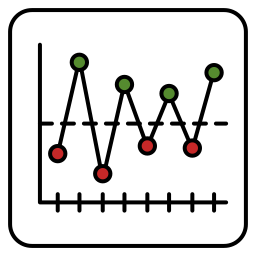
Control charts and process capacity analyses are among the tools that help to monitor and reduce variance, hence maintaining stability of processes. Consistent quality not only increases customer happiness but also reduces the need for costly rework and waste.

Identifying Root causes
Finding Root sources (RCA) goes beyond only addressing obvious issues to identify and repair the primary sources of flaws. RCA ensures that remedies address the actual cause of problems by searching out the genuine causes of quality concerns, therefore preventing recurrence of them.
Six Sigma makes frequent use of tools such Fishbone (Ishikawa) diagrams and the "5 Whys" to support this process. By focusing on core causes, one may avoid superficial solutions.

Continuous Improvement
Continuous improvement in Six Sigma is about making lasting positive changes that keep delivering quality as time goes on. After making improvements, the focus shifts to maintaining these gains with controls and regular checks. Ongoing improvements include documenting new methods, training team members, and setting up monitoring systems to keep track of performance.
This strategy makes sure that improvements become part of the organization’s standard practices, preventing setbacks and fostering a culture of continuous growth. Ongoing improvement brings lasting benefits over time, helping to create a steady increase in quality and efficiency.
How to Implement Six Sigma
Six Sigma has ideas and methods that focus on making business processes better and reducing mistakes. The main ideas of Six Sigma are often grouped into the DMAIC framework or DMAIC cycle, which means Define, Measure, Analyze, Improve, and Control:
1. Define
Goal
“Clearly identify the business problem, project goals, and customer requirements to establish the foundation for process improvement.”
Six Sigma’s Define phase focuses mostly on precisely stating the problem, establishing goals, and delineating project constraints. This stage looks at the whole process and points up the particular area that has to be changed. Important instruments utilized include SIPOC diagrams (Suppliers, Inputs, Process, Outputs, Customers), which offer a methodical perspective of the workflow, and the Project Charter, which details goals, scope, and team members. Techniques for Voice of the Customer (VoC) help to gather and assess consumer wants, therefore guaranteeing that the project meets consumer expectations. This first effort creates a concise issue description, therefore providing the team with a concentrated goal for the Six Sigma initiative.
- Clearly describe the issue or possibility for improvement.
- Determine project goals, scope, and objectives.
- Identify the major stakeholders and their requirements.
- Create a firm foundation for your improvement project.
2. Measure
Goal
“Gather baseline data on current process performance and establish reliable metrics to quantify the problem”
The Measure phase involves data collection to evaluate the present issue and establish a basis for comparison. This covers using check sheets and data collecting plans as tools for process analysis and data collecting. Gage R&R (Repeatability and Reproducibility) examines consistency; Measurement System Analysis (MSA) guarantees accuracy of measurements. Control charts and process maps let one see process performance.
At this point, careful data collecting is absolutely essential as it provides the basis for determining fundamental problems and gauging future development.
- Assess the current condition of the process using appropriate metrics.
- Create a data collecting strategy to obtain information about the process.
- Establish a baseline for performance and identify opportunities for improvement.
- Ensure that measurements are precise, consistent, and in line with project objectives.
3. Analyze
Goal
“Gather baseline data on current process performance and establish reliable metrics to quantify the problem”
Examining the gathered data helps one to find fundamental causes of problems in the Analyze phase. Several statistical instruments are applied, including Fishbone (Ishikawa) diagrams to enumerate plausible causes and Pareto charts to underline main sources of variance. Different aspects have correlations shown by hypothesis testing and regression analysis. Strategies like the 5 Whys and Failure Mode and Effects Analysis (FMEA) split out difficult issues for more thorough investigation of fundamental causes. The team may prioritize important enhancements for the upcoming phase with the aid of the acquired information.
- Analyze the data collected using statistical methodologies and tools.
- Identify patterns, trends, and possible causes of problems or deviations.
- Prioritize and validate fundamental root causes to concentrate on the most critical issues.
- Gain insight into the factors that affect process performance.
4 - Improve
Goal
“Develop, test, and implement solutions that address root causes and optimize process performance to meet customer requirements.”
Solutions produced, tested, and put into operation during the Improve phase target the root causes found in Analyze. Usually, creative problem-solving methods and brainstorming help one to find answers. Testing several process modifications to identify the most successful solutions can be done with the design of experiments (DOE) methods.
Before major deployment, prototyping and piloting let one test small-scale. Process redesign and workflow optimization techniques include these ideas into the current workflow after testing, therefore reducing faults and improving quality.
- Develop and implement solutions to address the identified root causes.
- Innovate and experiment with changes to optimize the process.
- Strive for efficiency and effectiveness in the new process design.
- Track and modify developments depending on comments and outcomes.
5 - Control
Goal
“Establish standardized procedures and monitoring systems to sustain improvements and prevent regression to previous performance levels.”
Maintaining the gains attained and avoiding a relapse to former behaviors is the key objective of the control phase. Monitoring process performance throughout time and spotting early problems can be done with control charts. Updated process documentation and standard operating procedures (SOPs) serve to guarantee that modifications find regular application.
Dashboards and other visual management tools increase the awareness of continuous performance; poka-yoke, or mistake-proofing, techniques assist stop reoccurring mistakes. Training and routine audits help to confirm the improvements and encourage long-term development by means of a quality-driven culture in the company.
- Set up control strategies to keep improvements over time.
- Install tracking systems to monitor continuous process performance.
- Create consistent operational guidelines to assure consistency.
- Apply preventative actions to stop defects from resurfacing.
How to Combine Six Sigma with Other Quality Tools
Problem Management is a FRAMEWORK for selecting and applying the right problem-solving methodology. The core methods (8D, PDCA, A3, Six Sigma, JDI) are described in the method selection section above. To execute these methods effectively, combine with these essential supporting tools:
5W2H Method
Structured problem definition before analysis begins. “What exactly happened, who was involved, when and where?” Problem Management uses 5W2H in D2 of 8D or problem definition phase of any method. Seven questions ensure complete problem understanding: What, Who, When, Where, Why, How, How Much. Thorough definition enables focused investigation.
Is-Is-Not Analysis
Problem definition and boundary setting. “Define exactly what the problem is and isn’t.” Problem Management uses Is-Is-Not in D2 of 8D or Problem Definition of A3. Precise problem definition prevents scope creep. Focused investigation.
Ishikawa Diagram
Systematic brainstorming of potential causes. “Team needs to identify all possible causes across 6M.” Problem Management uses Ishikawa in D4 of 8D or Analysis phase of A3. Visual cause categorization enables thorough investigation. Team alignment on cause hypotheses.
5-Why Analysis
Root cause identification within any methodology. “8D Step D4 – conduct 5-Why analysis.” Problem Management incorporates 5-Why as a tool within 8D, A3, or PDCA. Simple but powerful cause-and-effect reasoning. Gets to root cause, not symptoms.
Pareto Chart
Prioritization of problems and causes. “47 defect types – which ones matter most?” Problem Management uses Pareto to identify the vital few problems deserving investigation. 80/20 rule guides resource allocation. Focus on highest impact.
Histogram
Distribution analysis for root cause identification. “Is the process centered? What’s the spread?” Problem Management uses histograms to visualize process variation patterns. Shape reveals cause type: shift indicates tool wear; spread indicates variation source. Statistical evidence for root cause hypothesis.
SIPOC Diagram
Process overview for cross-functional problem understanding. “Where does this process start and end? Who’s involved?” Problem Management uses SIPOC to map Suppliers, Inputs, Process, Outputs, and Customers. Essential for problems spanning multiple departments. Clarifies process boundaries and stakeholders before investigation.
Quality Alerts
Rapid communication when quality issues occur. “Stop the line – quality issue detected!” Problem Management triggers Quality Alert for immediate containment action (D3 of 8D). Standardized format ensures fast, clear communication. Prevents suspect product from reaching customers. First line of defense.
FMEA
Risk identification and prevention. “After corrective action, update FMEA to reflect learning.” Problem Management connects to FMEA for prevention of future similar issues. Lessons learned feed forward into risk assessment. Problem-solving informs prevention.
Control Chart
Process monitoring and problem detection. “Control chart signaled out-of-control condition – investigate.” Problem Management receives signals from SPC that trigger investigation. After correction, control charts verify effectiveness. Statistical process control integration.
Check Sheet
Data collection for problem analysis. “Collect defect data before analysis.” Problem Management uses check sheets to gather evidence for root cause analysis. You can’t analyze what you haven’t measured. Evidence-based investigation.
Red Rabbit Test
Inspection process validation. “Are our inspections actually finding defects?” Problem Management uses Red Rabbit Test to verify detection capability. Known defective samples confirm inspectors catch issues. Critical after corrective action to ensure verification process works. Trust but verify.
Action Management
Task tracking for corrective actions. “8D defines actions – Action Management tracks completion.” Problem Management hands off to Action Management for implementation tracking. Multiple actions from one investigation need coordination. Accountability and follow-through.
Cost of Qualtiy (CoQ)
Financial justification and impact measurement. “What’s the cost of this quality problem?” Problem Management uses CoQ to prioritize problems and justify corrective action investment. Financial language for leadership. ROI of quality improvement.
OEE Tracking
Equipment-related problem identification. “OEE Quality factor shows 6% loss – investigate causes.” Problem Management receives signals from OEE that identify quality-related losses. Equipment focus for manufacturing problems. Integrated performance measurement.
Poka Yoke
Prevention implementation after root cause found. “Root cause identified – design Poka Yoke to prevent recurrence.” Problem Management often results in Poka Yoke as permanent corrective action. Error-proofing eliminates human error causes. Prevention beats detection.
Lessons Learned
Knowledge capture for organizational learning. “Successful resolution – capture for future reference.” Problem Management feeds Lessons Learned database. Similar future problems benefit from past solutions. Organizational memory.
Problem Prioritization Matrix
Severity and complexity assessment for method selection. “New problem – which method to use?” Problem Management uses prioritization matrix to route problems to appropriate methodology. Objective criteria for method selection. Consistent decision-making.
Benefits of Six Sigma
Improved Quality
Improved quality is a main benefit of Six Sigma. The structured approach helps solve problems by reducing defects in processes. By finding and removing the causes of variation and errors, Six Sigma projects make outputs more consistent and reliable.
This leads to better products and services. With this focus on accuracy and control, products are more likely to meet standards and customer needs. This helps to reduce issues like returns or warranty claims. A strong commitment to quality builds customer trust and loyalty since customers get products that often meet or exceed their expectations.
Increased Customer Satisfaction
Six Sigma’s goal of delivering excellent, consistent goods helps to increase customer satisfaction. Customers have less issues and delays as processes settle and products satisfy better quality criteria. Because consumers can rely on goods and services to regularly meet their demands, this dependability increases customer confidence and loyalty. A better customer experience results from which higher brand loyalty and repeat business follow.
Therefore organizations that effectively apply Six Sigma gain a competitive advantage by producing higher-quality products or services more efficiently than their competitors. This edge helps businesses stand out in the market and adds to long-term success.
Enhanced Efficiency
Six Sigma’s rigorous approach to process improvement inherently produces efficiency increases. Six Sigma smooths processes by identifying and eliminating phases that contribute nothing, therefore enabling speedier operations. Process mapping and root cause analysis enable teams to pinpoint inefficiencies and pointless stages, therefore enabling targeted adjustments that shorten lead times and accelerate manufacturing cycles.
Better procedures let employees spend less time duplicating items or correcting mistakes, therefore increasing production and freeing them to concentrate on tasks adding value. This increase in efficiency lets companies accomplish more with less, therefore offering a competitive edge in time and money.
Cost Reduction
Six Sigma projects mostly help to reduce costs. Less mistakes and rework result in significant financial savings. Six Sigma reduces waste in labor, time, and materials by looking at inefficiencies, therefore streamlining processes and lowering manufacturing costs. Reduced defective items also helps to minimize expenses related to warranties, repairs, and replacements.
Commonly found hidden inefficiencies by Six Sigma projects may be fixed to lower running costs, therefore increasing the competitiveness and profitability of the company.
Data-Driven Decision Making
Six Sigma emphasizes fact-based judgments, allowing businesses to steer their choices using data analysis rather than speculation. Six Sigma use statistical tools and structured approaches to offer a complete view of process performance and underlying problems. This concentration on data enhances objectivity and precision of decision-making, hence producing more consistent and quantifiable findings.
Data supporting every level of problem identification and solution implementation helps companies to lower errors, minimize bias, and provide workable, long-lasting solutions. Data-driven decision-making not only improves the immediate outcomes of Six Sigma initiatives but also encourages an analytical thinking culture and ongoing organizational development all around.
Limitations of Six Sigma
Resource- and Cost-intensive
Especially at first, Six Sigma often requires a lot of resources, time, training, and money—especially considering Important team members need to be qualified in Six Sigma techniques—such as Black Belts or Green Belts.
Also, it usually needs careful steps for collecting data, analyzing it, and testing it, which need special tools and skilled workers. Smaller businesses or those with little resources might find it difficult to justify this expenditure, especially in cases when quick profits are not obvious.
Inflexible
Six Sigma’s rigorous and methodical approach sometimes works against quickly changing or fast surroundings. Like DMAIC, Six Sigma has a rigorous structure with established stages that could impede flexibility in circumstances calling for rapid reactions or continuous changes and slow down decision-making.
This rigidity might contradict settings that value innovation, including tech companies whose success depends on experimentation and adaptation. Under these circumstances, the time spent on thorough research and Six Sigma check-in might impede the introduction of new ideas. This stifles creativity and perhaps slows down the company’s reaction to market developments or new prospects.
Resistance to Change
Since Six Sigma depends on data-guided choices and usually requires adjustments to current processes, strong employee support and a good organizational culture are absolutely essential if the technique is to be successful. Workers who are not totally involved or who do not perceive the value of Six Sigma may cause resistance against new ideas and measurements, therefore compromising project results.
Employees also have to respect and trust the data-based approach, which might demand a cultural change in companies accustomed to rely more on past performance or intuition. Usually, getting support requires early success demonstration to illustrate how Six Sigma supports corporate as well as personal goals, training, and open communication. Even well considered Six Sigma projects might find it challenging to provide the expected outcomes without personnel assistance.
Six Sigma Best Practices
Best Practices of Six Sigma are a good way to overcome most of the limitations above:

Focus on High-Impact Problems
Starting with significant issues is a wise approach when applying Six Sigma. Teams may concentrate on initiatives that will demonstrate the most obvious progress by identifying areas that might benefit a lot—such as procedures with numerous errors, significant expenditures, or direct impact on consumers.
This strategy allows the company to be energized as effective initiatives usually provide strong models of Six Sigma's advantages. Early resolution of important issues also helps to save resources, save expenses, and improve customer satisfaction, therefore strengthening the basis for continuous Six Sigma initiatives inside the company.

Invest in Training
Effective Six Sigma work depends on good training as the method calls for certain tools and procedures requiring knowledge to implement properly. Providing team members Six Sigma training—akin to Green Belt or Black Belt certification— guarantees their ability to manage projects with confidence.
Trained individuals reduce the possibility of errors by better locating root causes, data analysis, and solution development. Training also creates a consistent vocabulary and approach that unites the team around a shared knowledge of Six Sigma concepts, therefore increasing the odds of long-lasting success.

Encourage Continuous Learning
Maintaining a culture of development and adaptation in a Six Sigma environment depends on constant learning. Encouragement of team members to stay current with new tools, approaches, and best practices helps them to meet obstacles creatively. Offering more training, holding seminars, and pushing employees to share expertise will help organizations support this learning.
This emphasis on development not only raises the success of Six Sigma projects but also helps staff members to consider enhancements thoughtfully. By encouraging resilience and adaptation in a fast-changing environment, an always learning culture helps companies remain competitive.

Use the Right Tools
Six Sigma depends on the correct statistical and analytical techniques to provide precise insights that result in workable answers.
While control charts monitor process stability and identify trends, Pareto charts assist to concentrate on the most important problems. Other technologies like fishbone diagrams for root cause analysis and Failure Mode and Effects Analysis (FMEA) let teams clearly break down complex issues .
Six Sigma teams may make better data-driven decisions by carefully choosing and applying these technologies. Good tool utilization not only improves Six Sigma project efficiency but also result dependability, thereby increasing confidence in the Six Sigma process throughout the company.
Six Sigma Costs
The cost to use Six Sigma can differ a lot depending on things like how big the organization is, what kind of training is needed, and how big the projects are. Here are some common costs linked to Six Sigma:
1. Training Costs
- Yellow Belt Certification: Introductory level; typically costs between $200 to $500 per person.
- Green Belt Certification: For employees who will lead smaller projects; generally costs $1,000 to $3,000 per person.
- Black Belt Certification: Advanced training for leading major projects; costs around $7,000 to $12,000 per person.
- Master Black Belt Certification: For those overseeing Six Sigma strategy and training others; can range from $10,000 to $20,000 per person.
- Training costs can be reduced if an organization trains internal employees to become trainers.
2. Consulting and Implementation Support
- Consultants and Experts: Hiring external consultants, particularly for initial project setup, can cost between $100 to $300 per hour or higher, depending on the consultant’s expertise.
- Project-Specific Costs: Depending on project complexity, consulting fees can run from $10,000 to $100,000 or more per project. Larger organizations may need consultants for extended periods or multiple projects.
2. Project Costs (Tools, Software, and Resources)
- Statistical and Quality Software: Software like Minitab, JMP, or SigmaXL is commonly used for Six Sigma projects. Annual licenses typically cost $1,500 to $3,000 per user.
- Data Collection and Analysis Tools: Costs for data collection hardware, specialized testing equipment, or custom analytics tools may vary based on project needs, adding potentially $1,000 to $10,000 or more.
- Project Resources: Extra expenses for resources, like data analysts, quality engineers, or short-term project groups, can change a lot. Salaries and hourly pay are affected by the industry and the project size.
4. Employee Time and Resource Allocation
- Lost Productivity During Training: Employee training can make costs go up because it reduces how much work is done. This is especially true for Green and Black Belt candidates who may need to spend around 10 to 20 days or even more in training.
- Project Team Costs: Six Sigma projects usually require teams from different parts of the company. These teams need time for planning, meetings, and putting their plans into action, which represents a hidden cost in terms of personnel costs and time.
5. Long-Term Maintenance and Monitoring
- Control and Monitoring Costs: After a project is done, keeping Six Sigma improvements might need more data checking, routine process reviews, and constant worker training. This increases costs over time.
- Continuous Improvement Initiatives: A lot of businesses include Six Sigma in their ongoing improvement efforts, which could need regular retraining and resource spending, leading to yearly costs.
Overall Estimated Costs
- For a small business implementing basic Six Sigma principles or training a few team members, total costs can range from $10,000 to $50,000.
- For mid-sized organizations with multiple Green Belt or Black Belt projects, costs might range from $100,000 to $500,000 per year.
- Large corporations with extensive Six Sigma programs and Master Black Belts often invest $500,000 to several million dollars annually, depending on the scope and scale of their projects.
Six Sigma Example: Pizza Delivery
Six Sigma at Zero-Defect Pizza
1. Define
1.1. Problem Statement
Zero-Defect Pizza has lately a high rate of customer complaints related to delayed deliveries and incorrect orders.
Currently, around 15% of deliveries are late, and 8% have incorrect Pizzas, impacting customer satisfaction and repeat business.
1.2. Project Charter
Project Goals:
- Reduce late deliveries to less than 5%.
- Decrease order errors to below 2%.
- Achieve these improvements within six months to enhance customer satisfaction.
Scope:
- The project focuses on the delivery and order preparation processes at Zero-Defect Pizzeria’s main location.
Key Performance Indicators (KPIs):
- Percentage of on-time deliveries.
- Order accuracy rate.
- Customer satisfaction score from post-delivery surveys.
2. Measure
2.1. Data Gathering
Data gathering means closely watching and writing down the delivery details for each order that is completed.
Team members carefully write down the expected and real delivery times, as well as any differences between what was ordered and what was delivered. The order management system is used to keep track of when preparing starts, when it’s finished, and when the delivery is confirmed.
The team keeps track of time with exact timestamps for each step of the order processing process. After customers complete their orders, a short poll is sent to ask how satisfied they are with the delivery time and the accuracy of their orders.
2.2. Methods and Metrics
Tools Used:
- Control Charts to visualize delivery time consistency.
- Pareto Analysis to identify common sources of delays and errors.
- Process Mapping to document the order-to-delivery workflow, identifying key steps where issues may arise.
Baseline Metrics:
- Average delivery time and standard deviation.
- Current defect rates: 15% late deliveries, 8% inaccurate orders.
3. Analyze
3.1. Root Cause Analysis
Using tools like the Fishbone Diagram (Ishikawa) and 5-Whys, the team analyzes root causes of late deliveries and order inaccuracies.
Why are there staff errors during high-traffic hours?
Employees are overwhelmed due to high order volume.
Why is the high order volume causing errors?
There is no clear system for prioritizing and organizing orders efficiently.
Why is there no clear system for order prioritization?
The kitchen workflow lacks structured procedures and relies on manual decision-making.
Why does the workflow lack structured procedures?
There has been limited investment in standardized training and process optimization.
Why has there been limited investment in training and process optimization?
Management has focused more on increasing order capacity rather than refining operational efficiency.
3.2. Key Findings
Findings include:
- Order Preparation Issues: Staff errors during high-traffic hours lead to incorrect toppings or missing items.
- Delivery Delays: Inconsistent handoff times between kitchen and drivers, and inefficient delivery routing.
- Inefficient Workflow: Bottlenecks identified between order preparation and driver assignment, particularly during peak hours.
4. Improve
4.1. Proposed Solutions
1. Implement a Handoff Protocol:
Set up of an electronic standardized handoff point between the kitchen and delivery staff with specific time benchmarks. This ensures that drivers don’t wait for orders.
2. Standardize Preparation:
Introduction of a visual checklist for cooks and order preparers to verify each item before it is handed off for delivery.
3. Optimize Delivery Routes:
Usage of GPS and routing software to assign drivers to the fastest routes, updated in real time based on traffic conditions.
4.2. Testing
Zero-Defect Pizza pilots these changes on weekends (peak times) to monitor improvement in delivery time and accuracy.
4.3. Methods and Metrics
A structured experiment (DoE) was conducted to determine the impact of various process improvements on delivery time and accuracy
Experimental Groups:
Control group: No changes implemented
Test group 1: Implemented automated order prioritization
Test group 2: Introduced AI-assisted delivery routes
Test group 3: Adjusted employee shifts dynamically
Results indicated that automated order prioritization and AI-assisted routes led to a 30% reduction in late deliveries and a 20% improvement in accuracy rates.
5. Control
5.1. Establish Controls
Regular Monitoring:
Use control charts to track delivery times and accuracy rates, flagging any deviations from the target.
Ongoing Training:
Conduct monthly training refreshers on order checklists and handoff protocols.
Feedback Loop:
Continue collecting customer feedback and analyze for trends that may indicate reemerging issues.
5.2. Documentation
- Update of standard operating procedures (SOPs) to include the new checklist and routing protocols.
- Set up of dashboards to allow staff and managers to monitor on-time delivery rates and accuracy in real-time.
Results
By implementing Six Sigma principles, Zero-Defect Pizza successfully streamlined its order processing and delivery system. The structured improvements led to increased efficiency, higher customer satisfaction, and a reduction in order defects. These changes have established a sustainable quality control system, ensuring that Zero-Defect Pizza lives up to its name:
Late deliveries reduced to 4% (below target).
Order inaccuracies dropped to 1.5%.
Customer satisfaction improved by 18%.
Average delivery time improved from 35 minutes to 28 minutes.
FAQ Six Sigma
What is Six Sigma?
Six Sigma is a data-driven methodology and collection of tools used across various industries to improve efficiency and reduce defects.
It is based on statistical analysis and aims to reduce process variations, striving for a maximum of 3.4 defects per million opportunities.
Six Sigma was created by Motorola in the 1980s and became widely known when General Electric implemented it extensively under Jack Welch’s leadership. Since then, it has become a cornerstone of quality management worldwide.
When is Six Sigma used?
Six Sigma is used in manufacturing, healthcare, finance, and service industries to improve processes, reduce waste, and enhance product or service quality. It is particularly effective in:
Identifying and eliminating root causes of defects.
Enhancing efficiency and cost-effectiveness.
Increasing customer satisfaction.
Similar methodologies include:
A3: Proactive approach to closing performance gaps.
PDCA (Plan-Do-Check-Act): A continuous improvement cycle.
Just Do It: Immediate problem-solving techniques.
Why is Six Sigma used?
The main objective of Six Sigma is to create highly efficient processes by minimizing variation and errors. It helps organizations:
Improve customer satisfaction.
Reduce operational costs.
Enhance overall business efficiency.
What are the Six Sigma levels?
The following table illustrates how Six Sigma levels correlate with process quality and defect rates:
| Sigma Level | Yield (Good Products) | Defects Per Million (DPMO) |
|---|---|---|
| 1 Sigma | 30.85% | 690,000 |
| 2 Sigma | 69.15% | 308,000 |
| 3 Sigma | 93.32% | 66,800 |
| 4 Sigma | 99.38% | 6,210 |
| 5 Sigma | 99.9767% | 233 |
| 6 Sigma | 99.99966% | 3.4 |
As the Sigma level increases, defect rates decrease significantly, leading to higher quality and process control.
What are the core principles of Six Sigma?
Focus on Customer Needs: Understanding and meeting customer expectations through Voice of the Customer (VoC) feedback.
Find and Remove Errors: Identifying inefficiencies using tools like Pareto Charts, Statistical Process Control (SPC), and Failure Mode and Effects Analysis (FMEA).
Reduce Process Variation: Using control charts and process capability analysis to ensure consistent, high-quality outputs.
Identify Root Causes: Applying techniques like Fishbone (Ishikawa) Diagrams and the “5 Whys” to prevent recurring issues.
Continuous Improvement: Establishing monitoring systems to sustain improvements over time.
How is Six Sigma implemented?
Six Sigma follows the DMAIC framework:
Define – Identify the problem, set objectives, and determine project scope.
Measure – Collect data and establish baseline performance metrics.
Analyze – Identify root causes of defects using statistical tools.
Improve – Develop and implement solutions to address the root causes.
Control – Maintain process improvements through monitoring and documentation.
What are the benefits of Six Sigma?
Improved Quality – Reduces defects and enhances product reliability.
Increased Customer Satisfaction – Ensures better products and services.
Enhanced Efficiency – Eliminates waste and optimizes processes.
Cost Reduction – Saves money by improving productivity and reducing errors.
Data-Driven Decision Making – Uses statistics to guide business improvements.
What are the limitations of Six Sigma?
Resource and Cost-Intensive – Requires training (Green Belt, Black Belt certifications) and investment in data analysis tools.
Inflexibility – May not be ideal for rapidly changing environments.
Resistance to Change – Employees may struggle to adapt to new processes.
What are best practices for implementing Six Sigma?
Focus on High-Impact Problems – Start with projects that yield significant improvements.
Invest in Training – Ensure employees receive proper Six Sigma certification.
Encourage Continuous Learning – Adapt to new tools and improvement techniques.
Use the Right Tools – Implement statistical methods like control charts and Pareto analysis.
How much does Six Sigma cost?
The cost varies depending on training and project scope:
Yellow Belt Certification: $200–$500 per person.
Green Belt Certification: $1,000–$3,000 per person.
Black Belt Certification: $7,000–$12,000 per person.
Master Black Belt Certification: $10,000–$20,000 per person.
Other costs include consulting fees, software licenses (e.g., Minitab, JMP), and data analysis tools.