Quality Alert

Red warning light icon representing an incident or problem that requires immediate action.

What Is a Quality Alert?

A Quality Alert is system for formal notice used by companies to share info about a quality problem to the affected teams or groups inside the company. It acts as fast way to contain and deal with quality problems quickly.

Quality Alert Quick Guide

This guide explains what Quality Alerts are, why they matter, and how they help prevent quality problems before they escalate.

💡 Find real-world examples below.

Quality Alert is strong tool for quality that helps fast communication in a company when a customer complaint happens.

Graphic showing the objective of a quality alert: starting with a customer complaint, followed by issue identification, alert notification, problem resolution, and resulting in improved customer satisfaction.

Why Use a Quality Alert?

A Quality Alert mainly aims to minimize the effects of customer complaints by notifying the necessary staff so they can act quickly. Its goal is to improve customer satisfaction and uphold the company’s reputation.

When to Use a Quality Alert

Issue a Quality Alert when a problem threatens product quality, safety, or customer satisfaction and immediate action is required.

Typical triggers are:

Incoming Inspection Failures

When incoming parts or materials fail inspection, a Quality Alert immediately notifies production, warehouse, and purchasing. Sorting Actions prevent defective materials from entering the production process and documents the issue for supplier communication.

When operators or automated systems detect defects during production, a Quality Alert triggers immediate containment. The alert ensures affected work-in-progress is quarantined and prevents further defective output until the root cause is addressed.

When a customer reports a quality issue, a Quality Alert ensures rapid internal response. It documents the complaint using 5W2H, triggers inspection of remaining inventory, and initiates containment actions to prevent further affected products from shipping.

When quality issues are traced back to a supplier, a Quality Alert formalizes the problem documentation. It provides the supplier with clear 5W2H data, tracks containment across the supply chain, and creates a record for supplier performance evaluation.

When a potential safety hazard or regulatory non-compliance is discovered, a Quality Alert ensures immediate escalation. These high-priority alerts often require production stops, product recalls, and documentation for regulatory authorities like FDA or IATF auditors.

Quality Alert Principles

The major principles for effective quality alerts are:

Swift Communication 

Quality Alerts should be created quickly after a customer complaint comes in. Quick communication is very important for an effective Quality Alert use. Waiting too long to send out an alert can cause ongoing customer unhappiness and harm the company’s reputation. By quickly creating a Quality Alert as soon as a complaint is recorded, organizations can start solving the problem without wasting time, showing that they care about fixing customer issues quickly.

Personalized Distribution

Alerts should go to the departments and experts that can fix the issue. Focused distribution is important to prevent confusion and make sure that the right people know about and can act on the problems in the Quality Alert. By sending alerts to the specific teams in charge of the product or service, organizations can ensure that the right actions are taken by those who have the needed knowledge and power. This focused method avoids spreading responsibility too thin and helps make the resolution process easier, leading to a faster and better response.

Clear Instructions 

The alert needs to give clear instructions on what to do to fix the problem. Unclear or confusing guidance can cause errors and delays. Clear and direct instructions allow those responsible to grasp the problem’s extent, possible causes, and the exact actions needed to fix it. These directions should be straightforward, eliminating uncertainty, so everyone involved understands what to do and can work well toward a solution.

How to Create a Quality Alert

1. Log complaint

When a customer makes a complaint, it must be recorded. The first important step in the Quality Alert process is to make sure that all customer complaints are officially logged. This includes collecting information such as what the complaint is about, the customer’s contact details, and any necessary documents. Good documentation helps to understand the issue better and also creates a historical record for future use and examination.

2. Generate quality alert

After getting the customer complaint a Quality Alert is created, summarizing the complaint and its effects. This alert should provide a brief overview of the complaint, including how serious it is and what impact it may have on customers and the organization. It serves as the formal notice that starts the response process, making sure that all relevant parties know about the issue and its importance.

3. Notify affected groups

After the Quality Alert is created, it is important to quickly inform the teams or departments responsible for containing and fixing the problem. This notification should go to individuals who can take corrective action. Good communication at this point ensures that the right people are aware of the issue and can start investigations and problem-solving efforts.

4. Create action plan

Teams work on a plan to address the complaint. With the Quality Alert ready, the teams in charge need to work together to create a detailed action plan. This plan outlines what steps are needed to tackle the complaint, identifies who is responsible, and sets timelines for solving the issue. It might also include a root cause analysis to find out why the problem happened, helping to stop it from happening again.

5. Track progress

Progress is tracked, and the issue is resolved quickly. The Quality Alert process continues after the action plan is made. Regular follow-up is crucial to ensure that the actions planned are being carried out and that the issue is being solved effectively. Keeping track of progress helps to spot any obstacles or delays and allows for changes to be made as needed to speed up the resolution process. The main aim is to resolve the issue as fast as possible to reduce the impact on customers and the organization’s image.

Quality Alert – Real-World Examples

1. Pizza Production

Dough Pre-Mix

Professional Quality Alert template example from the food industry demonstrating how to document product defects, conduct 5W2H problem analysis, and track immediate containment actions.

💡 Want to create your own? Contact me for the free template.

2. Automotive / Manufacturing

Break Pad Assembly

 Automotive Quality Alert template example showing how to document critical safety defects, track supplier quality issues, and manage containment actions according to IATF 16949 standards.

💡 Want to create your own? Contact me for the free template.

3. Pharmaceutical Industry

PET Bottle Cap

Pharmaceutical Quality Alert template example demonstrating GMP-compliant defect documentation, FDA compliance tracking, and systematic containment actions for packaging defects.

💡 Want to create your own? Contact me for the free template.

4. Service Industry

Customer Onboarding

Service industry Quality Alert template example showing how to document process failures, track customer satisfaction impact, and implement corrective actions for service quality issues.

💡 Want to create your own? Contact me for the free template.

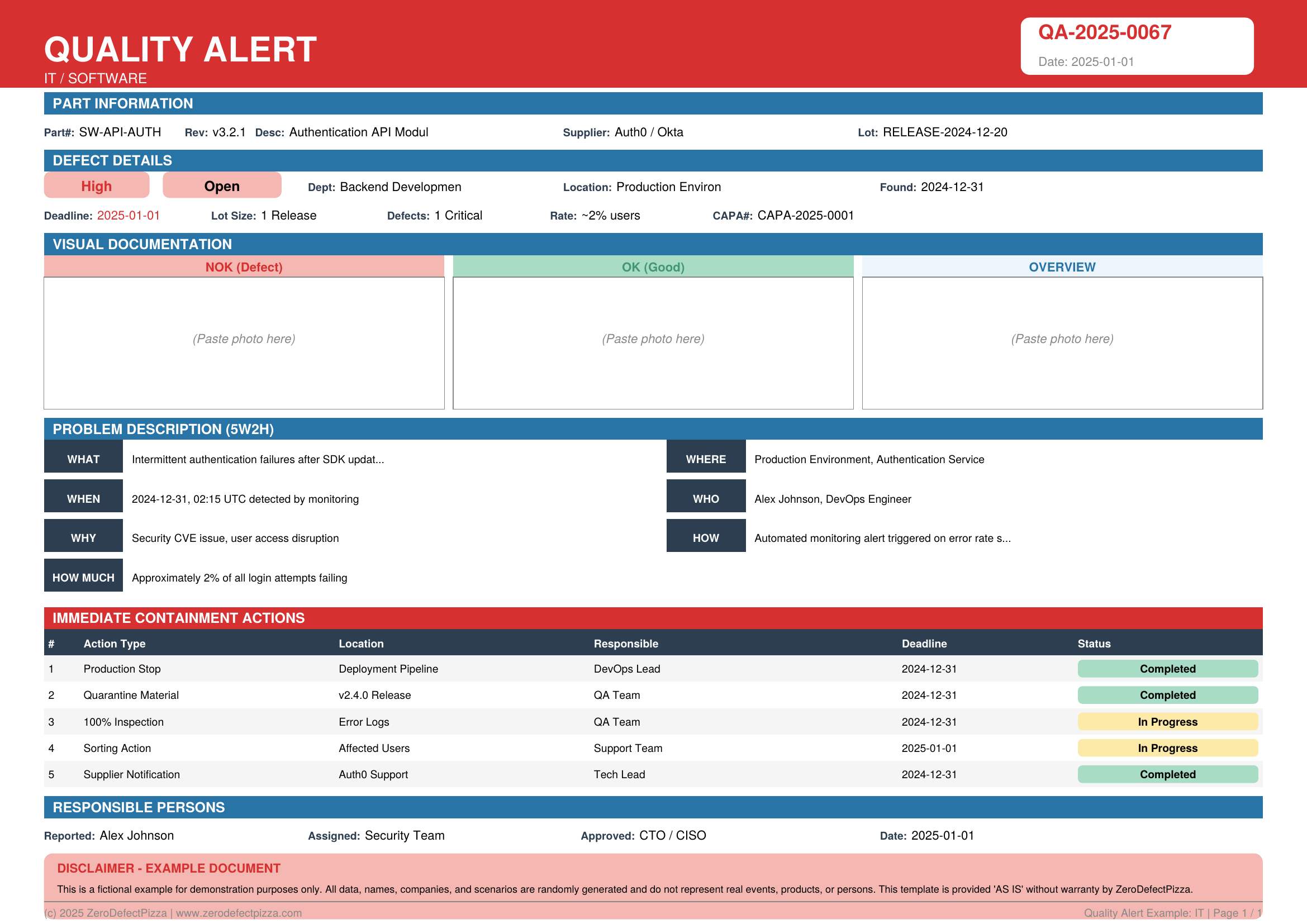
5. IT/Software Industry

API Authentication

 IT/Software Quality Alert template example demonstrating how to document critical system failures, track security incidents, and manage deployment rollback containment actions.

💡 Want to create your own? Contact me for the free template.

How to Combine Quality Alerts with Other Quality Tools

5W2H Method

Quality Alerts use 5W2H as their core documentation framework. The structured questions ensure no critical information is missed: What happened? Where? When? Who found it? Why does it matter? How was it detected? How much is affected? This creates a complete problem picture for all stakeholders.

After the initial Quality Alert captures what happened, Is-Is-Not Analysis helps narrow down the root cause. By comparing where the problem occurs versus where it doesn’t, teams identify patterns that point to specific causes – making subsequent investigations more focused and efficient.

Quality Alerts often trigger 8D investigations, especially for customer complaints or recurring issues. The alert provides the initial D1-D2 documentation (team formation and problem description), while the 8D process drives through root cause analysis, corrective actions, and prevention of recurrence.

When the Quality Alert identifies a complex problem with multiple potential causes, an Ishikawa (Fishbone) Diagram helps visualize all possibilities. The diagram organizes potential causes into categories (Man, Machine, Material, Method, Measurement, Environment), ensuring thorough root cause investigation.

Every Quality Alert generates containment actions that need tracking. Action Management ensures each task has a clear owner, deadline, and status. Integration between Quality Alerts and Action Management prevents actions from falling through the cracks and provides visibility into resolution progress.

Quality Alerts almost always trigger Sorting Actions as immediate containment. Defect detected → identify suspect inventory → segregate and inspect → release only conforming product. The Sorting Action documents inspection scope, defect rates, and ensures only good parts reach the customer. Alert without Sorting Action = incomplete containment.

After the Quality Alert captures the problem, 5-Why Analysis drills down to root cause. Symptom → Why? → Deeper cause → Why? → Root cause. This simple technique complements Ishikawa: Ishikawa → brainstorm all possible causes; 5-Why → verify the actual cause chain. Quick analysis for urgent alerts where full 8D investigation isn’t yet started.

Quality Alerts provide valuable input for FMEA updates. Alert issued → root cause found → FMEA update required. Every alert represents a failure mode that actually occurred: Occurrence rating → increase if failure happened despite controls; Detection rating → evaluate if controls need improvement. Reactive alert → proactive prevention through FMEA feedback loop.

When root cause reveals human error or process gaps, Poka Yoke provides the permanent solution. Quality Alert → identifies WHERE errors occur; Poka Yoke → ensures errors CAN’T occur again. Root cause = operator mistake → design mistake-proofing device; Root cause = wrong part → implement physical differentiation. Prevention beats detection → well-designed Poka Yoke eliminates future alerts on same issue.

Control Charts and Quality Alerts work bidirectionally. Detection direction: SPC signal (point outside limits, trend, pattern) → triggers Quality Alert → containment before customer impact. Verification direction: Corrective action implemented → Control Chart confirms process back in control → statistical evidence for alert closure. No SPC verification → risk of premature sign-off.

While Quality Alerts focus on immediate containment, CAPA addresses long-term prevention. After containment actions stop the bleeding, CAPA investigates the root cause and implements permanent corrective and preventive measures. The Quality Alert becomes the initiating document for the CAPA record.

Benefits of Quality Alerts

Rapid Response

One main advantage of using Quality Alerts is the quick reaction to customer complaints. When organizations issue Quality Alerts right after a complaint is received, they can start to fix the problem at once. This quick reaction is key to lessening negative effects on customers, showing that the organization is actively trying to solve issues. Quick reactions not only improve the organization’s image but also help keep customer trust, as customers value fast and effective responses to their problems.

Quality Alerts are important for bettering customer contentment. When customers notice that their complaints are taken seriously and acted on quickly, it shows a strong dedication to resolving their issues. This focus on the customer creates a positive view of the organization, which strengthens trust and loyalty. Better customer contentment can lead to more customers sticking around and can also result in good recommendations and more customer support, ultimately helping the organization’s financial success.

Another key advantage of Quality Alerts is how they help prevent the same problems from happening again. By quickly looking into and fixing the root causes of complaints, organizations can discover weaknesses or issues in their processes. This knowledge enables them to take proactive steps to avoid similar problems in the future. By learning from previous issues and continuously improving their quality control processes, organizations can lessen the chances of complaints coming back, enhancing the quality of products and services overall. This proactive strategy not only saves time and money but also helps build long-term customer satisfaction and brand reputation.

Limitations of Quality Alerts

Overuse

One drawback of Quality Alerts is that they can be used too much in a company. If a business sends out alerts for every customer issue, employees may become desensitized. When alerts happen too often, staff may see them as normal or not urgent, which reduces their drive to solve problems. To avoid this issue, companies should limit Quality Alerts to important complaints, making sure they are used wisely to keep their role as quick response tools effective.

Another drawback of Quality Alerts is that they may not provide a deep analysis of the issue. Though alerts are meant to be brief and focused on action, they may not explore the root causes of a problem thoroughly. This can create a need for further inquiry to completely understand why the issue happened. To combat this limitation, organizations should think about pairing Quality Alerts with deeper problem-solving techniques, like root cause analysis, to ensure that the main issues are closely examined and resolved, thus lowering the chances of them happening again.

Quality Alert Best Practices

Best practices for Quality Alerts include:

Focus on Urgency

A key point when using Quality Alerts is to focus on urgency. It is important to use Quality Alerts only for serious customer complaints that need quick action. Not every complaint is equally important, and sending alerts for small issues can weaken their impact. By using Quality Alerts only for serious situations that affect customer satisfaction and the company's reputation, you use this tool wisely. This focus makes sure that time and resources go to the most urgent problems quickly, making the tool work better.

Data Analysis

A crucial practice for getting the most from Quality Alerts is to use data review. Employ data analysis tools to collect, study, and understand data about customer complaints and Quality Alerts. This data-driven method helps organizations spot repeating issues and trends before they lead to many complaints. By tackling these root problems based on data findings, organizations can avoid future Quality Alerts and improve product or service quality. Data review also supports ongoing improvement, assisting organizations in refining their processes to reduce quality problems and customer complaints over time.

Quality Alert Example: Pizza Delivery

Quality Alert: Zero-Defect Alert Notification

Date: [Insert Date]
Alert Level: Critical
Alert Type: Zero-Defect Quality Alert
Product: Margherita Pizza (Large Size)
Departments Notified: Kitchen Staff, Quality Control, Procurement, Customer Service

Action Management Skills Breakdown Step by Step:

Flow diagram showing six steps of quality alert and problem solving in a pizza example, including hold preparation, inspection, root cause analysis, corrective actions, follow-up monitoring, and preventive actions.

1. Issue Summary

Complaint Source: Pizza Delivery

Complaint ID: [Insert Complaint ID]

Description of Issue:

Several customers say the big Margherita pizzas they got were not cooked enough in the center, which made the texture and taste bad. This alert about defects needs quick action to stop more problems and keep our promise to deliver perfect pizzas every time.

Impact:

        • Higher chance of unhappy customers and bad reviews.
        • Potential drop in returning customers.
        • Immediate threat to the restaurant’s quality reputation.

2. Immediate Action Required

Goal:

Maintain zero-defect quality by identifying, containing, and resolving the issue with the undercooked Margherita pizzas.

Primary Actions to Take:

1. Hold Preparation and Distribution of Affected Product:

        • Temporarily pause orders for large Margherita pizzas while the issue is investigated.
        • Redirect customers to alternative pizza sizes or types as needed.

2. Inspection and Testing:

        • Kitchen staff are to inspect the oven settings, particularly for large pizzas, ensuring temperature and cooking times meet established standards.
        • Conduct test bakes of the large Margherita pizzas to confirm cooking consistency.

3. Root Cause Analysis:

          • Investigate potential causes, such as oven calibration, dough thickness variations, or cheese distribution.
          • Perform a 5 Whys analysis to identify the exact source of undercooking.

3. Corrective Action Plan

      • Responsible Teams: Kitchen Staff, Quality Control, Equipment Maintenance
      • Timeline: Immediate adjustments within 24 hours and a thorough analysis within 48 hours.
      • Action Plan:
        • Change oven settings or cooking ways based on test outcomes.
        • Re-educate staff on how to prepare dough and put together pizza if problems are found.
        • Share results and fixes with all related teams to guarantee uniform results in the future.

4. Follow-Up and Monitoring

  • Hourly Monitoring:
    • Quality Control to oversee baking consistency for all large pizzas over the next 48 hours.
    • Customer Service to monitor incoming feedback for any further reports of undercooking.
  • Completion Report:
    • A final report will be put together in one week. It will include main cause findings, actions taken to fix issues, and any changes to procedures to keep the zero-defect standard.

5. Preventive Action

  • Oven Calibration Schedule:
    • Ensure ovens are calibrated monthly to maintain consistent baking performance.
  • Staff Training:
    • Reinforce training on pizza assembly and cooking techniques to prevent future inconsistencies.
    • Establish a checklist for staff to verify correct dough thickness and topping distribution on all large pizzas.

FAQ Quality Alert

What is a Quality Alert?

A Quality Alert is a formal notice used by companies to communicate information about a quality issue to the affected teams or departments within the organization. It acts as a rapid response tool to contain and address quality problems effectively.

Quality Alerts are essential for maintaining strong quality control processes and ensuring prompt communication when customer complaints arise.

Quality Alerts notify relevant teams when a customer reports a product or service quality issue. This ensures that corrective actions are initiated quickly, preventing further issues and improving product quality before more customers are affected.

The primary objective of a Quality Alert is to minimize the impact of customer complaints by quickly informing the necessary staff so they can take immediate action. It aims to:

  • Improve customer satisfaction.

  • Maintain the company’s reputation.

  • Ensure swift corrective and preventive action management (CAPA).

  • Reduce risks and prevent recurrence.

  • Support continuous quality improvement.

The primary objective of Quality Alerts is to ensure a rapid response to customer complaints, thereby enhancing customer satisfaction and maintaining the organization’s reputation.

Quality Alerts have their roots in Total Quality Management (TQM) and Six Sigma methodologies and gained prominence in the 20th century as organizations recognized the need for swift responses to customer concerns.

  1. Swift Communication – Quality Alerts should be created and distributed immediately after a complaint is received to prevent escalation.

  2. Personalized Distribution – Alerts should only be sent to the departments and teams responsible for resolving the issue, avoiding unnecessary involvement of unrelated personnel.

  3. Clear Instructions – The alert must provide precise guidance on the required actions to resolve the problem efficiently and avoid confusion or delays.

  1. Receipt of Complaint – Customer complaints are officially recorded, including relevant details and documentation.

  2. Quality Alert Generation – A Quality Alert is created, summarizing the issue, severity, and potential impact.

  3. Notification – The appropriate teams and stakeholders are informed immediately so they can initiate action.

  4. Action Plan Development – A corrective and preventive action plan is created, assigning responsibilities and setting timelines.

  5. Follow-Up – Progress is monitored, and issue resolution is tracked to ensure effective closure.

The benefits include:

  • Rapid response to customer complaints
  • Enhanced customer satisfaction
  • Prevention of recurring issues
  • Overuse – Excessive alerts may lead to employees ignoring them, reducing their effectiveness.

  • Lack of Depth – If not properly documented or followed up, alerts may fail to provide long-term solutions.

  • Focus on Urgency – Use Quality Alerts only for serious complaints that require immediate action.

  • Data Analysis – Regularly analyze alert trends to identify and address recurring issues.

  • Clear and Concise Communication – Ensure Quality Alerts are easy to understand and contain actionable instructions.

A manufacturing company that receives a customer complaint about a defective product batch. A Quality Alert is issued, notifying the production and quality control teams. Production is halted for that batch, an investigation is conducted, and corrective actions are taken promptly to prevent further defects, ensuring customer satisfaction and preserving the company’s reputation.

Table of Contents
    Add a header to begin generating the table of contents
    Newsletter
    social media
    related post

    Have you ever wondered why some problem-solving efforts succeed while others fail? I have seen thousands of 8D reports and......

    “What is quality?” or “What are you exactly doing in quality?”, sometimes people, my family or friends are asking. After......

    “I’d rather clean the toilets in our office building than doing that.” That was my reaction when I was asked......

    RELATED Modules
    Ready to cut Quality Issues, boost Customer Satisfaction, and keep your Team happy?

    Join Zero Defect Pizza and discover powerful tools, proven methods, and expert insights to minimize defects, maximize customer satisfaction, and keep your teams motivated—one slice at a time. Schedule a meeting or explore our resources today.

    Contact Form

    Name
    Newsletter
    Newsletter Sign-Up
    Name
    Contact