Incident Management

What Is Incident Management?

Incident Management is a methodical way of finding, reacting to, and solving unplanned events or problems in a company. In quality management, it is important for keeping and enhancing product or service quality by quickly dealing with any changes, interruptions, or failures in processes.

Incident Management originated in IT service management, especially within the Information Technology Infrastructure Library (ITIL). Its concepts have been adjusted and broadened to fit different sectors beyond just IT over the years.

Incident Management – Real-World Examples

1. Pizza / Food Service

Order Processing Incident

Complete incident management industry example for food service. Shows systematic 5W2H incident capture applied to restaurant operations: Wrong toppings on customer order (pepperoni instead of vegetarian), Priority Medium, single customer affected. Root cause analysis identified order handoff communication gap. Immediate actions: replacement pizza prepared, full refund processed, server briefed on order verification protocol.

💡 Want to create your own? Contact me for the free template.

2. Automotive / Manufacturing

Safety-Critical Weld Defect

Complete incident management industry example for automotive manufacturing. Shows IATF 16949-compliant 5W2H incident documentation: Incomplete weld seam on front subframe (penetration < 80% spec), Priority High, 47 suspect units in containment window. Cost impact estimated at €125,000. Immediate actions: Line B stopped, all suspect units quarantined, Robot #3 parameters locked out pending investigation.

💡 Want to create your own? Contact me for the free template.

3. Pharmaceutical / Life Sciences

Cold Storage Temperature Excursion

Complete incident management industry example for pharmaceutical production. Shows GMP-compliant 5W2H deviation documentation: Refrigerator R-07 reached 9.2°C (spec: 2-8°C) for 47 minutes, Priority High, 1,200 vials ($2.4M batch value) at risk. Detection via automated SCADA monitoring. Immediate actions: batch quarantined, stability assessment initiated, maintenance dispatched for equipment inspection.

💡 Want to create your own? Contact me for the free template.

4. Service Industry

SLA Breach – Extended Wait Time

Complete incident management industry example for service operations. Shows systematic 5W2H incident capture for customer service: Average wait time 25 min (SLA: 15 min) during morning peak, Priority Medium, ~40 customers affected with 3 walkouts. Revenue impact estimated at $1,500. Immediate actions: 2 additional staff called in, priority callbacks offered, Monday staffing schedule reviewed.

💡 Want to create your own? Contact me for the free template.

5. Information Technology

Critical ERP System Outage

Complete incident management industry example for IT operations. Shows structured 5W2H incident response for enterprise systems: SAP production instance unresponsive, all users disconnected at 14:22, Priority High, 500+ users affected across all departments. Business impact estimated at $50,000/hour. Immediate actions: incident bridge call initiated, DR failover in progress, business notified via mass communication.

💡 Want to create your own? Contact me for the free template.

Why Use Incident Management?

The main goal of Incident Management in quality is to lower the effects of interruptions on product or service quality. It seeks to return to normal operations quickly and in an organized manner, while also finding root causes to stop future problems.

When to Use Incident Management

Incident Management is used in various industries like IT, healthcare, and manufacturing. It aids organizations in keeping operations steady, lowering downtime, and improving customer satisfaction by handling and learning from incidents in an organized way.

Customer Complaints / Incidents

When customers report defects, delivery issues, or service failures, incident management captures everything. “Customer called – product doesn’t work. What happened?” Every complaint becomes a tracked incident with owner, deadline, and resolution. Customer voice → Systematic response.

When production unexpectedly stops, every minute costs money. “Line 3 is down – what’s happening?” Incident management captures the event, tracks downtime, assigns troubleshooters, and documents resolution. Chaos → Structured response.

When defective products reach the customer or downstream process, fast action is critical. “Bad parts shipped to customer – how many, which lots?” Incident management enables rapid containment, sorting, and notification. Escape identified → Containment started.

When workplace injuries occur or are narrowly avoided, documentation is legally required. “Worker injured at Station 5 – what happened?” Incident management captures details for OSHA compliance and prevention. Every near-miss recorded today prevents an injury tomorrow.

When critical equipment fails unexpectedly, structured response minimizes downtime. “CNC machine shows error code – production blocked.” Incident links to maintenance action, parts ordered, root cause analysis. Equipment failure → Maintenance workflow triggered.

When incoming materials fail inspection or cause production problems, supplier accountability begins. “Supplier batch failed incoming inspection – entire delivery affected.” Incident documents the issue, triggers supplier notification, tracks corrective action. Supplier problem → Documented evidence for claims

When IT systems fail or security breaches occur, ITIL-compliant incident management kicks in. “ERP system down – 150 users affected.” Incident captures impact, escalation path, resolution steps, and lessons learned. System failure → Structured IT response.

When internal or external audits identify issues, incidents track corrective actions. “ISO auditor found documentation gap – needs correction.” Audit finding becomes incident with deadline, owner, and evidence of closure. Audit finding → Tracked to closure.

In regulated industries, every deviation requires documented investigation. “Batch temperature exceeded limit for 15 minutes – is product affected?” GMP incidents require formal investigation, impact assessment, and regulatory notification. Deviation → Investigation protocol.

When SPC charts signal out-of-control conditions, incident management documents the event. “Control chart shows special cause – what happened at 10:15?” Incident captures the deviation, links to root cause analysis, and tracks correction. SPC alarm → Documented response.

When environmental events occur (spills, emissions, waste issues), regulatory documentation is required. “Chemical spill in loading dock – containment needed.” Environmental incidents require specific handling, reporting, and prevention measures. Spill contained → Incident documented.

When service commitments are missed, incidents track the failure and correction. “Customer waited 47 minutes – SLA is 15 minutes.” Service incidents drive process improvement and customer recovery actions. SLA missed → Improvement opportunity captured.

When safety issues require product recalls, incident management coordinates the response. “Field reports of overheating – potential recall needed.” Incident tracks affected units, customer notifications, replacement logistics. Recall decision → Coordinated action.

Automotive OEMs require immediate notification of quality issues. “Customer plant reports sorting action – incident report due in 24h.” Automotive incidents have strict timelines and format requirements. OEM notification → Compliant response.

Key Principles of Incident Management

Incident Management is guided by the laws of:

Early detection

Early detection is key in Incident Management, stressing the importance of spotting incidents early on. This allows organizations to react quickly, stopping issues from growing and reducing potential harm to operations and quality.

This principle highlights the need for careful monitoring, active reporting systems, and ongoing observation to quickly catch any deviations from normal operations.

Categorization

Categorization means sorting incidents by how serious they are and how much they affect the organization. This method provides a clear way to respond to incidents, helping to use resources wisely.

By categorizing incidents, organizations can focus on the most important problems first. This sorting also helps with communication within the organization, creating a shared understanding of the urgency and significance of each incident.

Prioritization

After incidents are categorized, the Prioritization rule is used, helping organizations to focus on urgent high-impact incidents.

This makes sure that available resources are used to tackle the most important issues first, reducing possible negative effects on operations and quality. Good prioritization depends on a clear understanding of the business goals and the potential effects of each incident, which enables a focused response.

Resolution

The Resolution principle highlights the importance of quickly fixing and addressing incidents. This means taking actions that not only bring operations back to normal but also stop the same issues from happening again.

Resolution needs teamwork among key people, good communication, and a clear method for applying fixes. Effective resolution helps the organization be stronger and keeps its quality standards up.

Learning

Learning is an important principle that looks at events to find out why they happened. By knowing the main reasons for incidents, organizations can take steps to stop them from happening again.

Learning is about always getting better, where each event is a chance to improve. This idea helps organizations change and upgrade their processes, building a culture of constant improvement and strength when things change.

How to Implement Incident Management

1. Log the incident

Incident logging starts the Incident Management process. It means writing down details about the incident. This includes explaining what happened, its type, and how it affects operations or quality. Logging incidents correctly and on time is important because it supports the next steps in Incident Management.

Good documentation helps everyone communicate well, helps sort and rank incidents, and gives a history for future review and improvement.

2. Categorize

Categorization is the methodical sorting of incidents into known categories. This process includes arranging incidents by their characteristics, effects, and other important factors. Creating clear categories aids in making the incident management process easier, ensuring a more organized response.

Categorization is crucial for prioritization, as it enables organizations to swiftly evaluate the kind and seriousness of each incident, leading to a clearer and more efficient resolution.

3. Prioritize

Once an incident has been documented and categorized, the next step is prioritization.

This prioritization helps allocate resources effectively and ensures that critical incidents are addressed first. It acts as a decision-making guide to determine which issues need immediate attention and which can wait.

It’s important that priority is based on impact and urgency — not gut feeling. A structured evaluation process ensures that everyone shares a common understanding of what needs to be handled first. This keeps the team focused, enables quick responses to risks, and helps prevent greater damage.

4. Investigate

Investigation is a step for organizations to look into the incident and find out the main reasons. This needs a careful look at the factors that contributed to the incident, trying to know the basic problems that caused the issue. Good investigation needs teamwork among relevant parties, access to important data, and the use of problem-solving methods.

Finding root causes is important for creating lasting corrective actions that fix the current incident and stop it from happening again later.

5. Solve

Solving is the step where we deal with and fix the incident. This phase includes taking corrective actions to get back to regular operations and stop similar incidents from happening.

Successful resolution needs teamwork from the incident response team, clear communication, and following set procedures. The aim is to not just address the issue at hand but also to improve processes for lasting stability and better quality.

6. Document and Learn

Documentation is a important part of the Incident Management process. It means keeping a full record of the incident and how it was solved. This includes logging the incident, categorizing it, prioritizing, investigating, and the steps taken to resolve it.

A good record is helpful for analysis, audits, and improving processes. It offers historical views which help in finding patterns, trends, and where the organization can enhance its incident response.

How to Combine the Incident Management with Other Quality Tools

Vorfallsmanagement ist ein ERFASSUNGS- & VERFOLGUNGSSYSTEM – es verbindet Ereignisse mit Analyse und Lösung. So integriert es sich:

8D Report

Incidents capture WHAT happened; 8D investigates WHY and HOW to prevent recurrence. Simple incidents close directly; complex ones escalate to 8D. “Incident shows repeated bearing failures – needs 8D investigation.” Incident triggers 8D → 8D resolves incident. Event capture → Deep analysis

When incident root cause isn’t obvious, 5-Why digs deeper. “Incident: Wrong parts shipped. Why?” Each “why” reveals the chain of causes until the true root emerges. Incident describes symptom → 5-Why finds disease.

When incident has multiple potential causes, Ishikawa organizes the investigation. “Production incident – is it Man, Machine, Material, or Method?” Fishbone structures brainstorming around the 6Ms. Incident triggers investigation → Ishikawa organizes causes.

When incident affects some products/lines/shifts but not others, Is-Is-Not reveals patterns. “Defects on Line 1 but not Line 2 – what’s different?” Is-Is-Not systematically compares affected vs. unaffected conditions. Incident pattern → Systematic comparison

Incidents generate actions; Action Management tracks them to completion. “Incident requires 5 corrective actions – who owns what?” Every incident action gets owner, deadline, status tracking. Incident identified → Actions tracked to closure.

When incident requires immediate communication, Quality Alert broadcasts the warning. “Critical defect found – all shifts need to know NOW.” Quality Alert provides rapid notification; Incident provides the documentation. Urgent communication → Documented event.

When incident is resolved, lessons prevent recurrence elsewhere. “Incident resolved – what can other plants/teams learn?” Lessons Learned captures knowledge for organization-wide benefit. Single incident → Organization-wide learning.


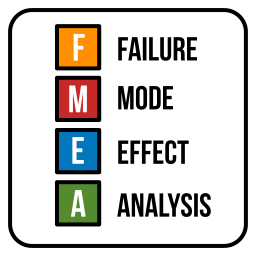
Incidents reveal risks FMEA missed or underestimated. “This failure mode wasn’t in FMEA – add it now.” Real incidents update FMEA severity, occurrence, and detection ratings. Incident data → FMEA improvement.

When incident reveals control gaps, Control Plan gets updated. “Incident occurred because we didn’t check this parameter – add to Control Plan.” Incidents drive Control Plan evolution. Incident lesson → Control Plan update.

Control Charts detect problems; Incidents document the response. “Control chart flagged out-of-control – incident captures what we did.” SPC + Incident = detection + documentation. Detection system → Documentation system.

When many incidents accumulate, Pareto identifies where to focus improvement. “50 incidents this month – which categories cause 80%?” Pareto prioritizes incident categories for systemic improvement. Incident data → Prioritized improvement.


In regulated industries, significant incidents require formal CAPA. “GMP incident requires documented corrective and preventive action.” CAPA formalizes the incident resolution for regulatory compliance. Incident → Formal CAPA process.

When incident investigation needs data, Check Sheets provide structured collection. “Incident suggests pattern – let’s collect data to confirm.” Check Sheet gathers evidence for incident analysis. Hypothesis → Data collection → Confirmation.

Equipment incidents directly impact OEE metrics. “Machine incident caused 2 hours downtime – reflected in Availability.” Incident duration feeds OEE calculations. Incident downtime → OEE impact quantified.
Quality is one OEE component. Control Charts monitor the Quality rate in real-time, feeding OEE calculations. Out-of-control quality conditions directly impact OEE scores – making the business case for SPC visible.

When incident reveals human error potential, Poka-Yoke prevents recurrence. “Incident: Operator selected wrong part. Solution: Poka-Yoke fixture.” Incident insight → Error-proof solution. Reactive fix → Proactive prevention.

Benefits of Incident Management

Enhanced Quality

A major benefit of using Incident Management is better quality of products or services. By quickly fixing incidents in an organized way, companies can find and correct problems with quality before they get worse.

This active method helps create a culture of ongoing improvement, making sure that products and services meet or go beyond what customers expect. Quick fixes of incidents not only stop possible flaws but also support a focus on quality within the whole organization, which improves the customer experience overall.

Incident Management helps keep operations stable by reducing downtime and ensuring business runs smoothly. Quick spotting and fixing of issues stop interruptions to important processes, systems, and services. Less downtime helps productivity and efficiency, letting organizations have a steady workflow.

Stability in operations is important for meeting deadlines, satisfying customer needs, and keeping overall business performance strong. By managing incidents well, organizations can create a strong operational setting that is more ready to deal with unexpected problems.

One main benefit of Incident Management is how it helps customer satisfaction. By quickly fixing incidents, companies reduce interruptions to services or products, allowing a smooth experience for customers. This active approach shows a focus on customer needs and builds trust in the organization’s dependability. Customers like businesses that manage issues well without hurting the quality or delivery of their services.

Improved customer satisfaction can lead to customers coming back and promotes good word-of-mouth, strengthening the organization’s image in the market.

Limitations of Incident Management

Dependency on Detection and Reporting

Incident Management is a useful method to fix problems, but it relies heavily on accurate and timely reporting of incidents. If reporting has gaps or delays, it may slow down how quickly an organization can respond.

Missing or late information can cause incidents to be misclassified or poorly prioritized, which can affect how well the incident management process works overall. This issue highlights the need for strong reporting systems and a work environment that motivates employees to report incidents quickly as they happen.

A main limit of Incident Management is how much it needs resources. Doing incidents well takes time, people, and sometimes money for good investigations, fixing problems, and keeping records. Needing skilled workers and fast responses can put pressure on organizational resources, especially when things are hectic.

It can be tough to balance resource use for incident management with other important tasks, so organizations must think carefully about the costs and benefits to use their resources wisely in keeping an effective incident response system.

Incident Management Best Practices

Regular Training

An important advice for good Incident Management is to have regular training for staff, making sure they can identify and report incidents well. By having training sessions, organizations help their employees see possible incidents early, promoting a culture of alertness.

Trained staff help with quick and correct reporting of incidents, which improves the Incident Management process. Ongoing training also keeps staff informed about new risks and response methods, strengthening the organization’s ability to face new challenges.

Continuous Improvement

A good practice in Incident Management is to see each incident as a chance to learn and use the data collected for ongoing improvement. By looking at incident data, organizations can spot patterns, main causes, and parts of their processes that need betterment.

This repeated approach helps to improve incident response procedures, put preventive steps in place, and build a culture that values learning and change. Accepting ongoing improvement based on incident data not only boosts the Incident Management system but also helps make the organization's operations and quality management efforts stronger and more efficient.


Incident Management Example: Pizza Delivery

Zero-Defect Pizza: Ensuring High-Quality Operations

Zero-Defect Pizza has also a pizza delivery business that aims to provide flawless pizzas to clients punctually. To ensure quality and keep customers happy, they use Incident Management to deal with any issues that arise in their operations. Here, we will explore how they use each principle and step of Incident Management to reach their goal of “Zero Defect” in their pizza delivery service.

Incident Scenario: Late Delivery and Cold Pizza

A situation happened when a customer got a pizza 20 minutes late, and it was not warm when it arrived. This caused a customer complaint, which Zero Defect Pizza considers as very important because it affects customer happiness directly.

1. Log incident

A staff member inputs the incident into the system, noting delivery time, temperature on arrival, and customer opinions. It’s labeled as a “Quality Incident – Late and Cold Delivery,” which could affect customer happiness.

Purpose:

This log helps keep things clear and allows everyone to understand how the incident impacts business and customer relations.

2. Categorize

Category:

The incident is categorized under “Delivery Issues” and “Temperature Control Issues.”

Purpose:

This categorization enables the team to quickly recognize recurring issues and guides them to a solution protocol for delivery and temperature problems. It also allows managers to allocate resources based on known problem types.

3. Prioritize

Priority Level:

The incident receives high priority due to its negative effect on customer satisfaction and potential harm to brand image.

Purpose:

By making this issue a priority, the company ensures that the team pays attention immediately, reassigning resources to investigate and fix this high-impact issue before it happens again.

4. Investigate

Process:

The team looks into possible root causes, checking factors such as:

      • Order preparation time: Was the pizza made and allowed to cool before the driver got there?
      • Driver delay: Did the driver get stuck in traffic, or was there a mistake in the delivery address?
      • Packaging: Did the packaging fail to keep the pizza warm?

Outcome:

The investigation shows that the delay was due to the order being incorrectly marked as ready too soon, leading to a 15-minute wait for the driver.

5. Resolve

Actions Taken:

Based on findings, the following steps are taken:

Process change:

The company updates its order system to mark pizzas as “ready” only when they’re in a warming oven.

        • Staff training: Delivery drivers and kitchen workers are retrained on timing to ensure pizzas leave right after they’re ready.
        • Improved packaging: Tested insulated delivery bags start being used to keep heat longer.
          Goal: By refining software and staff practices, Zero-Defect Pizza aims to prevent future delays and preserve pizza quality during delivery.

6. Document and Learn

Record Keeping:

The incident, investigation, and corrective measures are documented. This log allows for pattern analysis, checking if delivery issues arise often and need better processes.

Learning Outcome:

Team leaders study data over months and notice incidents happen more on weekends. They add staffing and change scheduling to guarantee timely deliveries during busy times.

      •  

Results

Better Quality:

By fixing problems in making, timing, and packing, Zero-Defect Pizza lowers the chance of cold pizzas, making sure customers get a hot and fresh item.

Steady Operations:

Solving timing and messaging issues ahead of time results in more stable operations, cutting down on problems and lessening customer complaints.

Customer Happiness:

Fast and clear reactions to issues produce a good experience for customers, strengthening their belief in Zero-Defect Pizza’s promise of quality.

FAQ Incident Management

What is incident management?

Incident management in quality control refers to a systematic approach used to identify, assess, and address unexpected events, issues, or deviations that can affect the quality of a product or service.


Incident management is used to respond to incidents that can impact product or service quality. It involves documenting, analyzing, and resolving issues to prevent their recurrence.

The primary objective is to ensure that quality standards are met consistently by identifying and addressing deviations promptly.

Incident management has its roots in various quality improvement methodologies, such as Total Quality Management (TQM) and Six Sigma. It has evolved as a crucial component of quality control in modern industries.

The key principles on incident management include:

  • Early Detection: Identifying incidents as soon as they occur.
  • Documentation: Thoroughly recording incident details.
  • Analysis: Investigating root causes to prevent recurrence.
  • Corrective Actions: Implementing solutions to mitigate the incident’s impact.

To implement incident management, follow these steps:

  1. Identification: Recognize and document incidents.
  2. Assessment: Evaluate the impact and severity.
  3. Investigation: Analyze the root causes.
  4. Resolution: Implement corrective and preventive actions.
  5. Monitoring: Continuously track and review incidents.

The benefits include:

  • Improved product quality.
  • Enhanced customer satisfaction.
  • Reduced waste and defects.
  • Increased operational efficiency.
  • Continuous improvement culture.

Limitations may include:

  • Incomplete incident reporting.
  • Inadequate data analysis.
  • Resistance to change.
  • Resource-intensive.
  • Focus on symptoms, not underlying issues.

Best Practices for Incident Management include:

  • Foster a culture of reporting without fear of blame.
  • Use data analysis tools to identify trends.
  • Implement corrective actions promptly.
  • Continuously train and involve employees.

A manufacturing company that produces electronic devices. They notice an increase in customer complaints about defective screens. Incident management would involve:

  • Identification: Gathering reports of defects from customers and the production line.
  • Assessment: Evaluating the impact on customer satisfaction and production costs.
  • Investigation: Analyzing the manufacturing process to identify the root cause, which could be a faulty supplier component.
  • Resolution: Implementing corrective actions, such as changing the supplier and improving quality control checks.
  • Monitoring: Continuously tracking product quality and customer feedback to ensure the issue is resolved and doesn’t recur.
Table of Contents
    Add a header to begin generating the table of contents
    Newsletter
    social media
    related post

    Have you ever wondered why some problem-solving efforts succeed while others fail? I have seen thousands of 8D reports and......

    “What is quality?” or “What are you exactly doing in quality?”, sometimes people, my family or friends are asking. After......

    “I’d rather clean the toilets in our office building than doing that.” That was my reaction when I was asked......

    RELATED Modules
    Ready to cut Quality Issues, boost Customer Satisfaction, and keep your Team happy?

    Join Zero Defect Pizza and discover powerful tools, proven methods, and expert insights to minimize defects, maximize customer satisfaction, and keep your teams motivated—one slice at a time. Schedule a meeting or explore our resources today.

    Contact Form

    Name
    Newsletter
    Newsletter Sign-Up
    Name
    Contact