



Have you ever wondered why some problem-solving efforts succeed while others fail? I have seen thousands of 8D reports and problem sheets throughout my career and I learnt to spot the quality of a doomed or successful problem solving process within seconds.
Why? Very simple and not a secret: Garbage In, Garbage Out. Therefore he quality of your initial information determines your entire outcome.
This post reveals how to master this challenge very easily and how the 5W2H method transforms chaotic problem solving into structured success.
The Problem with Poor Information
Picture this: A detective arrives at a crime scene, glances around, and writes “Dead man” in their report.
Sounds ridiculous, right? Yet this is exactly how most problem-solving reports read.
When teams rush to solve issues without proper data, two things happen:
- They achieve sub-optimal results
- They waste time and money gathering information they should have collected from the start

Poor information creates a cycle of inefficiency. Teams chase solutions without understanding problems. They implement fixes that don’t address root causes. And they repeat this cycle with each new issue.
The 5W2H Solution
The answer is surprisingly simple: 5W2H.
The 5W2H method is a structured approach to information gathering. It ensures you have complete data before starting any problem-solving process. The name comes from the seven questions it answers:
- Who: Who discovered the problem? Who is affected? Who needs to be involved?
- What: What exactly happened? What is the extent of the issue?
- When: When did it first occur? When was it noticed?
- Where: Where did the problem happen? Where in the process/product?
- Why: Why is this important to solve?
- How: How did the problem occur? How was it discovered?
- How Much: How many items/people are affected? What is the financial impact?

These seven questions gather everything you need. They create a solid foundation for your problem-solving process.

Real Problem vs. Poor Description
Let me show you the difference:
Poor description:
“Machine stopped working.”
5W2H description:
- What: Machine #103 stopped mid-cycle with error code E-42
- Why: Production line halted, causing delivery delays
- Where: Assembly plant B, production line 2
- When: Tuesday, March 15 at 2:17 PM, during normal operation
- Who: Operator Jason Williams was running the machine
- How: A grinding noise occurred, then the error appeared
- How much: $5,000 per hour in lost production, affecting 3 customer orders
See the difference? The first description gives you nothing to work with. The second gives you a clear starting point.
Why 5W2H Works When Other Methods Fail
Most problem-solving efforts jump straight to solutions. The 5W2H method forces you to pause and gather critical context first.
Think of it like building a house. You wouldn’t start without a blueprint. Yet companies regularly launch problem-solving initiatives without a clear picture of the issue.

Why Teams Skip This Step
People rush past proper problem definition because:
- They think they already know the answer
- They feel pressure to show quick action
- They don’t have a simple framework to follow
- They’ve never been taught the importance of problem definition
These are all mistakes. A few minutes spent on good problem definition saves hours or days later.
How to Implement 5W2H Today
Step 1: Create a Standard Template
Develop a one-page form with sections for each 5W2H question. Keep it simple but thorough.
Step 2: Train Your Team
Teach everyone the importance of complete information. Show examples of good and bad problem statements.
Step 3: Make It Digital
The 5W2H method works perfectly in IT systems. Create digital forms that:
- Require all fields to be completed
- Allow file attachments for evidence
- Can be easily shared with stakeholders
Step 4: Review Before Proceeding
Establish a quick review process. Don’t start problem-solving until all 5W2H questions have complete answers.
The IT System Advantage
Traditional 8D reports happen after problems occur. The AI approach involves constant monitoring.
1. Advanced Implementation
You can create simple forms with these seven questions. Make them required fields. This forces teams to collect proper information from the start.
You can add a list of values (LOV) to many fields for easier and structured data entry. The structured
Many companies add these fields to their:
- Customer service platforms
- Quality management systems
- Project management tools
- Production tracking software
- Maintenance request systems
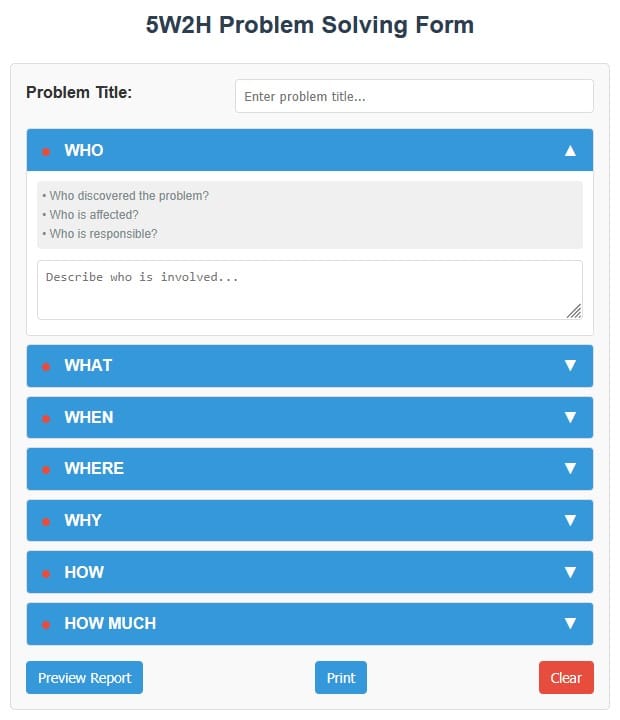
2. Simple Implemation
A very simple and unexpensive way to implement 5W2H is to add a 5W2H template to your description field. Here’s how it works:
- It adds a button next to the field labeled “Insert 5W2H Template”
- When clicked, it inserts a ready-made template with all 5W2H questions

How to Beef up your 5W2H
Take it one step further by dividing the questions into supplier and customer views:
Supplier View:
- What did we provide?
- Why did we do it this way?
- Where did we make it?
- When did we deliver it?
- Who created it?
- How did we produce it?
- How much did it cost us?
Customer View:
- What problem did they experience?
- Why does it matter to them?
- Where do they use our product?
- When did they notice the issue?
- Who is affected on their side?
- How does it impact their process?
- How much is it costing them?
See the difference? The first description gives you nothing to work with. The second gives you a clear starting point.
Common Questions About 5W2H
Is 5W2H Too Time-Consuming?
No. The method typically takes 10-15 minutes to complete. Compare this to the hours or days wasted solving the wrong problem.
Can 5W2H Work for Any Industry?
Yes. While it originated in manufacturing, the method works for software development, customer service, healthcare, and virtually any field where problems need solving.
How Is 5W2H Different from Root Cause Analysis?
5W2H happens before root cause analysis. It gathers the information you need to perform effective root cause analysis later.
Why Many 8D Processes Fail
The 8D (Eight Disciplines) problem-solving process is powerful. Yet many 8D efforts fail because they start with weak problem definitions.
The first “D” in 8D is “Define the Problem.” Without 5W2H, this definition lacks substance. Teams end up solving symptoms instead of causes.
My Point of View
I’ve seen thousands of problem-solving attempts. The pattern is clear. Success depends on starting with good information.
The 5W2H method isn’t fancy. It isn’t complicated. It doesn’t require expensive training. It simply works.
Before you jump to solutions, take time to answer these seven questions. Your problem-solving process will be faster, cheaper, and more effective.
Remember: Garbage in, garbage out. The quality of your input determines the quality of your results.