

Is Cost of Quality Silently Draining Your Business?
Most companies lose 20-40% of revenue to poor quality—but don't know where. This video shows you the Cost of Quality framework: how to calculate prevention costs, appraisal costs, and failure costs. Learn why 66% of quality budgets go to firefighting failures instead of preventing them, and see the ROI calculation that proves prevention pays.
You'll learn: COQ calculation • The 4 cost categories • ROI: $3-10 saved per $1 invested
Video Transcript
Do you know that you might be losing money for quality problems in your business even after correcting them? What if I told you about a method that gives you an insight into how much money you are losing on maintaining the quality of your product and how you can minimize these expenses? If you are wondering what this mystery method is, let me introduce you to Cost of Quality (COQ).
It's a fairly simple concept to understand using our Zero Defect Pizza example. Basically, Cost of Quality is the sum of all expenses that result from quality problems and defects. These costs fall into two main categories. First, we have Cost of Good Quality (COGQ)—costs you spend upfront to make sure quality is high. Think of them as good investments that help you avoid bigger costs later.
Prevention costs include money spent to prevent problems before they happen: staff members learn proper dough handling techniques, monthly maintenance keeps ovens working perfectly, fresh ingredients arrive from trusted suppliers each morning, and clear recipes ensure every pizza meets the same high standard.
Appraisal costs include money spent checking your work: each pizza gets a temperature check before leaving for delivery, managers sample sauces daily for consistent flavor, quick inspections catch any flaws before pizzas reach customers, and delivery times appear on a tracking board to prevent cold arrivals.
The next category is Cost of Poor Quality (COPQ)—costs that hit you when quality fails. They drain your profits and waste resources. Remember, the goal is to reduce these costs as much as possible.
Internal failure costs are money lost when you catch mistakes before customers do: burnt pizzas go straight to the trash, orders with wrong toppings need complete remaking, poorly prepared dough results in wasted ingredients, and pizzas sitting too long become cold and unsellable.
External failure costs include money lost when customers find your mistakes: cold pizzas trigger automatic refunds, customer complaints lead to replacement orders at no charge, bad experiences turn one-time buyers into lost customers, and staff must spend extra time handling complaint calls instead of making new orders.
Plus, we have opportunity costs—the money you could have made if you didn't have quality problems: unhappy customers never return for a second order, negative reviews scare away potential new business, a damaged reputation limits growth opportunities, and competitors gain market share while quality issues get fixed.
So, how can we calculate the costs of quality when it comes to making and delivering a pizza? The first step is to identify the activities that lead to additional costs. In Zero Defect Pizza, we'll have to train our staff for dough prep and topping accuracy ($10,000) and conduct quality checks for ingredient freshness and oven temperatures ($15,000).
Next, there would be internal failure costs such as scrap dough, burned pizzas, and re-prepared orders in house ($20,000). There would also be external failure costs like customer complaints addressed through free replacements, refunds, and worst case, lost sales ($30,000).
The good costs include prevention and appraisal costs, totaling $25,000. The poor costs include both internal and external failure costs, totaling $50,000. When we add up all the costs, our pizza place's total Cost of Quality is $75,000.
Finally, we analyze the results to gain key insights. The percentage expenditure on good quality is 33.3%, while the percentage for poor quality is 66.7%. These numbers show that 66.7% is spent on failures, which indicates significant losses due to poor quality.
How can we lower this number? We can make a higher investment in prevention (better staff training) and appraisal (stricter quality checks), which can help reduce failure costs over time. By reducing the chances of error, we can cut down overall costs as well. If we're making fewer mistakes, we're spending less money on dealing with their aftermath.
To improve the Cost of Quality, a balanced approach is needed. This involves investing in prevention and appraisal while reducing the costs of failure. Examples include implementing prevention-oriented actions like quality training programs, investing in process improvement, reducing failure costs by monitoring production closely and listening to customers, balancing spending through tracking quality costs, and building a quality culture.
If you implement these measures correctly, your company quality will go from being a financial burden to an advantage. A significant investment in staff training and preventative measures will save you capital in the long run.
The proportion of total quality costs in relation to sales will be lower, meaning higher profit margins with the same amount of sales. Your customers will be more satisfied and loyal for a longer time because of the better products they receive.
However, there are a few limitations to this method: difficulty in measuring opportunity costs (lost potential revenue or delayed market entry), people usually focus on short-term risks, and this method is resource-intensive. But it is well invested if you can focus your resources more on prevention rather than expensive firefighting and problem fixing with unhappy customers.
How Quality Problems drive Quality Costs
Cost of Quality (CoQ) is the expenses resulting from quality problems either in terms of avoidance in the first place or correction of their effects.
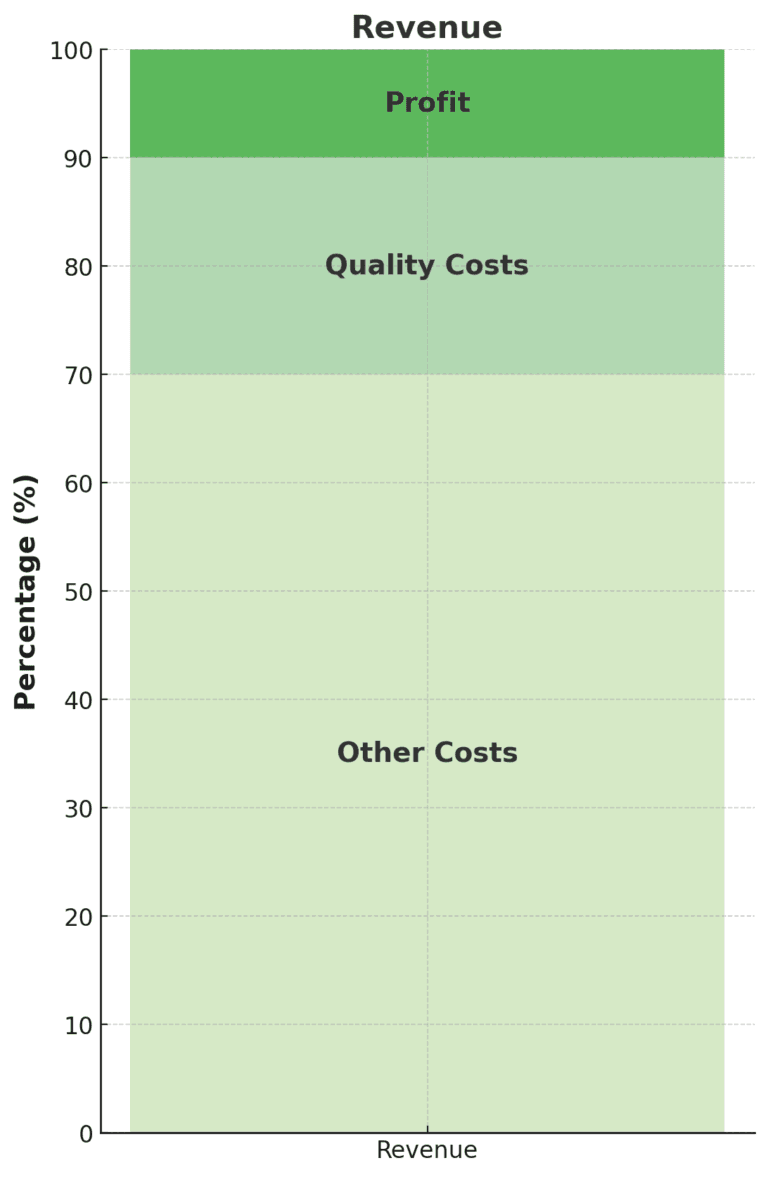
Depending on the industry quality costs make between 5% and 15% of the revenue. According The American Society for Quality (ASQ) the Cost of Quality can even range somewhere between 15 – 20% of sales, and can be as high as 40% in some companies. So the cost of quality is a significant expense for organizations.
As cost of poor quality eat up a big chunk of the revenue, they can heavily impact the profit margin of a company. Even move the profit magin to negative and imposing a major thread to a company’s existence.
The good news is, that controlling quality costs is a fairly easy and effective way to boost profit margins and a company’s success from two sides.
Test Your Cost of Quality Knowledge
Test your understanding with 10 quick questions about the Cost of Quality. A simple way to review key ideas and see how poor quality impacts your bottom line

Types of Quality Costs
The cost of quality encompasses both the cost of preventing quality problems and the cost of addressing quality issues. It includes investments in prevention activities, such as quality planning, training, and process improvement, as well as the expenses incurred to fix quality issues, such as rework, scrap, and warranty claims.
To gain a deeper understanding of the cost of quality, it is important to explore the different categories of quality cost. These categories provide a framework for organizations to identify and track their quality expenses.

Prevention costs
Definition:
Prevention costs include all the investments made to prevent quality problems from occurring in the first place.
Objective:
The goal of prevention costs is to minimize the occurrence of defects, errors, and failures, thereby reducing the overall cost of quality.
Examples of Prevention Costs include:

- Quality Planning: Designing robust products or services with fewer chances of defects
- Implementing quality management systems and certifications
- Employee training on quality techniques and procedures
- Performing supplier evaluations and quality audits
- Process Improvement
Appraisal Costs
Definition:
Costs to avoid quality issue by assessing the quality of products or services.
Objective:
Identify deviations and remove defects before products or services reach customers, reducing the likelihood of expensive recalls, repairs, or customer complaints.
Examples of appraisal costs include:

- Quality Planning: Designing robust products or services with fewer chances of defects
- Implementing quality management systems and certifications
- Employee training on quality techniques and procedures
- Performing supplier evaluations and quality audits
- Process Improvement
Internal Failure Costs
Definition:
Internal failure costs are the expenses incurred when quality problems are detected and corrected before products or services are delivered to customers. These costs arise from defects found during the production process or while providing services internally.
Objective:
Avoid negative impact on production efficiency and customer satisfaction.
Examples of internal failure costs include:

- Rework and repair of defective products
- Scrap and waste materials
- Downtime and production disruptions due to quality issues
- Lost labor and machine time
External Failure Costs
Definition:
External failure costs are incurred when defects are detected after products or services have been delivered to customers and in the worst case detected by the customer.
External failure costs are the most significant concern for companies as they can severely damage the reputation of the organization and lead to loss of customers and market share.
Objective:
Limit the negative impact on customer satisfaction and legal consequences.
Examples of External Failure Costs include:

- Customer support and handling of complaints
- Warranty repairs and replacements
- Product recalls and associated expenses
- Product returns
- Legal fees and settlements due to quality-related lawsuit
Opportunity Costs
Definition:
Opportunity costs represent the loss of potential benefits, revenue, or competitive advantage when resources are tied up addressing quality-related problems instead of focusing on value-creating activities. These costs arise indirectly due to quality problems, missed opportunities, and the resulting impact on customer satisfaction or dissatisfaction, including the willingness to buy.
Though Opportunity Costs are not always explicitly classified within the traditional CoQ framework, they are considered a genuine and important part of the broader concept of Cost of Quality (CoQ).
Objective:
Minimize opportunity losses by addressing quality problems effectively to maximize productivity, revenue, and customer satisfaction.
Examples of opportunity costs include:

- Orders or contracts lost due to delays, defective products, or failure to meet customer expectations.
- Loss of valuable expertise, knowledge, or skills caused by focusing on correction rather than process improvement.
Lost Know-How
Definition:
The permanent loss of expertise, experience, and institutional knowledge that occurs when employees leave an organization due to quality-related issues and bad press.
This loss can significantly impact operational efficiency, product quality, and the company’s ability to maintain consistent standards, often resulting in increased costs for training replacements and potential deterioration of service or product quality.
Objective:
Limit the negative impact on employee satisfaction and legal consequences.
Examples of Costs for Lost Know-How include:

- Knowledge Transfer and Training Costs
- Recruitment and Hiring Costs
- Productivity Impact Costs
- Morale and Culture Costs
- Customer Relationship Costs
- Innovation and Development Costs
Where do Cost of Quality occur?
The cost of quality is not limited to a specific industry or sector. It impacts organizations across various sectors, including manufacturing, healthcare, and service industries.
Manufacturing
In the manufacturing industry, the cost of quality can be seen in the expenses incurred to address defects in products, such as rework, scrap, and warranty claims. For example, a car manufacturer may incur significant costs to fix quality issues in its vehicles, including replacing faulty parts and providing warranty repairs.
Heathcare
In the healthcare industry, the cost of quality can be observed in the expenses incurred to address medical errors and patient safety issues. This includes the cost of medical malpractice claims, additional treatments required due to errors, and the impact on patient satisfaction and trust.
Service
In the service industry, the cost of quality can be seen in the expenses incurred to address customer complaints and service failures. For example, a hotel may incur costs to compensate dissatisfied customers, provide refunds, or improve service standards to prevent future complaints.
How to calculate the Costs of Quality
1. Identify Activities
Break down quality-related activities into Cost of Good Quality and Cost of Poor Quality, aligning them with the four CoQ categories:
Cost of Good Quality (COGQ):
- Prevention Costs: Proactive costs to prevent defects.
- Appraisal Costs: Costs to measure and verify quality.
Cost of Poor Quality (COPQ):
- Internal Failure Costs: Costs from defects before delivery.
- External Failure Costs: Costs from defects after delivery.
2. Calculate Costs for Each Category
- Sum the Cost of Good Quality:
COGQ = Prevention Costs + Appraisal Costs
- Sum the Cost of Poor Quality:
COPQ = Internal Failure Costs + External Failure Costs
3. Calculate Total Cost of Quality
Add the two components together:
Total CoQ = COGQ + COPQ
Total CoQ = (Prevention Costs + Appraisal Costs) + (Internal Failure Costs + External Failure Costs)
4. Analyze the Results
Compare the proportion of Cost of Good Quality (COGQ) and Cost of Poor Quality (COPQ):
- A higher COPQ indicates that failure costs dominate, meaning quality issues need more attention.
- Increasing COGQ (prevention and appraisal) can reduce COPQ over time.
Visualize the distribution of CoQ:

Benefits
Enhanced Decision-Making
By quantifying costs across prevention, appraisal, and failure categories, CoQ provides actionable insights for prioritizing quality investments. This enables organizations to allocate resources effectively, focusing on prevention and appraisal to minimize failure costs over time. It helps decision-makers balance short-term expenditures with long-term quality benefits, improving overall operational efficiency.

Increased Customer Satisfaction
High-quality products and services lead to fewer defects and enhanced reliability, resulting in happier customers. Monitoring CoQ allows organizations to address quality issues proactively, ensuring that customer expectations are consistently met or exceeded. This translates into higher customer loyalty, better reviews, and increased market share.

Cost Reduction and Profitability
Understanding and managing CoQ helps organizations reduce waste and inefficiencies associated with poor quality. By focusing on prevention, companies lower their failure rates, reducing costs associated with rework, warranty claims, and customer complaints. The reduction in failure costs leads directly to improved profitability.

Improved Competitive Advantage
Organizations with robust quality management systems derived from CoQ analysis often outperform competitors by delivering reliable, defect-free products faster. This competitive edge can lead to stronger brand reputation and increased customer trust, positioning the company as a leader in quality.Organizations with robust quality management systems derived from CoQ analysis often outperform competitors by delivering reliable, defect-free products faster. This competitive edge can lead to stronger brand reputation and increased customer trust, positioning the company as a leader in quality.

Support for Continuous Improvement
CoQ provides a framework for ongoing quality improvement by identifying trends in quality costs and areas for optimization. Tracking these costs enables organizations to measure the effectiveness of quality initiatives over time, fostering a culture of continuous improvement.

Limitations
Difficulty in Measuring Opportunity Costs
While direct costs like prevention and failure are relatively easy to track, opportunity costs—such as lost revenue or delayed market entry—are more abstract and harder to quantify. This limitation can lead to an incomplete picture of the true cost of quality, potentially underestimating the impact of poor quality on business outcomes.

Short-Term Focus Risks
Organizations might focus too much on reducing visible costs (e.g., cutting prevention or appraisal efforts) without understanding their long-term consequences. This can lead to increased failure costs later, undermining the value of quality initiatives. A balanced view of CoQ requires sustained commitment, which not all companies achieve.

Resource Intensity
Implementing and monitoring a CoQ system can be resource-intensive. It requires skilled personnel, detailed data collection, and ongoing analysis, which can strain smaller organizations or those with limited budgets. This initial investment may discourage businesses from adopting CoQ frameworks fully.

Resistance to Change
Organizations with deeply ingrained processes or cultures may resist CoQ implementation, viewing it as an unnecessary burden. This resistance can hinder the adoption of best practices in quality management, limiting the potential benefits of CoQ.

Inconsistent Definitions and Standards
CoQ methodologies may vary across industries and organizations, leading to inconsistent application. For example, what one company considers a prevention cost might be categorized differently by another. These inconsistencies can complicate benchmarking and reduce the comparability of CoQ metrics across organizations.

Strategies for Improving Cost of Quality
In order to improve the Cost of Quality effectively, a balanced approach is needed, which involves making investments in prevention and appraisal while reducing the costs of failure. Here is a list of measures that companies can take to optimize their CoQ.
1. Prevention-Oriented Actions
Deploy a comprehensive Quality Management System
It is recommended to use the frameworks that are already available, such as the ISO 9001, Lean Six Sigma, or Total Quality Management.
They provide the structure required for systematic quality management and therefore make sure the quality principles are adhered to all over the organization. Regular management reviews help to keep the focus on quality performance and stimulate continuous improvement.

Expand Quality Training Programs
Extensive quality training provides employees with the relevant knowledge and skills to recognize and eliminate quality problems. In this way, companies enable their employees to master the quality issues within their departments and thus become the internal experts who drive the improvements.
On-going education strengthens the thinking and acting quality is everybody’s responsibility thus forming a culture where quality improvement is the concern of all.

Integrate Quality during Product and Process Design
By committing to quality considerations in the design phase, organizations can avert dealing with extremely costly issues down the road.
The methodologies of Design for Six Sigma and Failure Mode and Effects Analysis are useful tools in forecasting potential failure points prior to their influence on production.
Quality Function Deployment is a process that helps to ensure customer requirements are turned into product specifications accurately.
Enhance Supplier Quality Management
Supplier quality is a component that can directly impact organizational quality performance. The selection criteria for suppliers should be rigorous and include continuous audits to ensure that they sustain compliance with quality expectations.
Collaborative improvement programs with important suppliers yield mutual benefits and bolster supply chain quality.

Invest in Process Improvement
Improvement in the process can be achieved by adopting corrective measures only and not taking reactive measures that end up causing more problems.
Utilizing Statistical Process Control, organizations can manage process stability and recognize variations before they can cause defects.

The root cause analysis mechanisms such as 5-Why and Fishbone diagrams offer solutions to underlying problems, therefore, addressing root cause rather than symptoms.

2. Appraisal Optimization Actions
Reinnovate Inspection Techniques
The implementation of automated inspection systems increases precision and at the same time, reduces the labor costs. Risk-based methods are utilized to determine which inspection areas will have the greatest effect on production quality.

Amplify Testing Methodologies
Accelerated life testing yields quicker results on product durability. The Design of Experiments helps in the optimization of test parameters in order to gain maximum information while using minimal resources. The use of standardized test procedures will yield the same outcomes in test methods irrespective of the products or teams.

Reinvent Quality Data Collection and Analysis
Digital quality management systems are by far the most effective means of collecting data, thus they are more efficient and have a lesser margin of error than manual methods. The availability of dashboards that display real-time data enables quick responses to quality issues that may crop up.
The augmentation of analytics is an essential tool that allows one to identify hidden patterns and emerging trends that would be difficult to observe otherwise

3. Reduce Internal Failure Costs
Internal failures happen when you catch problems before customers do. These costs include scrap, rework, and production delays. Though costly, they’re much cheaper than external failures.
Create a Fix-It System
Set up a clear process for handling problems when they occur. Don’t just fix symptoms – find what really caused the issue.
Use methods like 8D to dig deep and fix root causes. Document solutions so everyone learns from each problem. Track if fixes really work over time or if problems come back. Good systems stop the same errors from happening again and again.

Monitor Production Closely
Check work at key points in your process before adding more value. This catches problems early when they cost less to fix.
Train workers to spot and report issues rather than passing them on. Give them authority to stop work when needed. Regular checks create a rhythm of quality awareness. They also show workers that quality truly matters to the company.

Reduce Scrap and Rework
Find why parts fail and fix those causes rather than just making more parts. Each piece of scrap represents wasted materials, labor, and machine time. Train workers on proper methods to get things right the first time. Update tools and equipment when they can’t meet quality needs. Look for patterns in scrap to find deeper problems. Less waste means lower costs and better delivery performance.
Design with Mistake-Proofing (Poka-Yoke) tools that make errors impossible. Simple guides that only allow parts to fit one way prevent assembly errors. Light sensors that stop machines when parts are missing catch problems early. These tools cost little but save a lot by preventing mistakes.

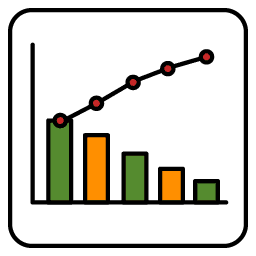
With Pareto Charts create simple charts that show which defects happen most often. Focus on the top three problems first to get the biggest gains. Track progress weekly with clear, visual updates. Teams can see if their fixes are working or not. This tool helps you spend time on what matters most.
4. Reduce External Failure Costs
External failures happen when customers find problems you missed. These include warranty claims, returns, and lost customers. They cost far more than internal failures and damage your reputation.
Listen to Customers
Make it easy for customers to give feedback about your products. Every complaint is a free consulting report about your quality. Measure how happy customers are using surveys and follow-up calls. Track how many customers buy again after having a problem fixed. Use customer input to make changes to products and processes. Customers often spot problems you miss because they use products differently than you expected.

Handle Warranties Better
Study warranty claims to find patterns that show design or production flaws. Each warranty claim holds valuable information about real-world product performance. Create fair warranty rules that protect customers without excessive costs.
Keep good records of all warranty work and costs by product type. Make repairs quick and easy to minimize customer frustration. Good warranty service keeps customers loyal even when products fail.

Improve Complaint Handling
Respond quickly to customer problems with genuine concern. Speed matters as much as the solution itself. Train staff to solve issues with care and without blaming customers. Give service teams the power to make things right without multiple approvals. Learn from each complaint by tracking them in a database. Good service can turn unhappy customers into loyal ones who tell others about their positive experience.

5. Balance the Spending
Quality costs money, but poor quality costs much more. Smart companies move money from fixing failures to preventing them. This shift reduces total costs while improving quality.
Track Quality Costs
Measure quality costs every three months to see if they’re going up or down. Count all costs including prevention, inspection, and failures. Compare your numbers with other companies in your industry to see how you stack up. Set clear goals for lower costs that everyone understands. Create simple charts to show progress to all employees. What gets measured gets improved, especially when everyone sees the results.

Shift Money to Prevention
Slowly spend more on prevention activities like training and process improvement. This isn’t about spending more overall – it’s about spending smarter. Show leaders how this saves money by tracking reduced failure costs.
Present the business case with real numbers from your company. Rely less on finding defects and more on preventing them from happening. Every dollar spent on prevention saves five to ten dollars in fixes later.

Create a Quality Plan
Make a multi-year quality plan with clear goals and action steps. Good quality doesn’t happen by accident – it requires planning. Set goals to prevent problems rather than just getting better at fixing them. This fundamental shift takes time but brings lasting benefits. Link quality work to business goals like growth and profit.
Show how quality supports what the company wants to achieve. Long-term plans bring lasting results that short-term fixes never will.

6. Build a Quality Culture
Quality happens when everyone cares about it. A strong quality culture means fixing systems, not blaming people.
Lead by Example
Set quality goals for leaders that are clear and measurable. What leaders check and talk about shows what really matters. Include quality in performance reviews for managers at all levels. Good quality starts at the top and flows downward.
Show quality matters through actions, not just words. Leaders who ignore quality problems teach everyone else to do the same. Those who highlight quality create a culture where excellence matters.

Reward Quality Work
Recognize people who improve quality, not just those who fix problems. Catching issues early deserves more praise than heroic fixes later. Include quality in job reviews for everyone, not just quality staff. People focus on what affects their pay and advancement. Celebrate quality wins publicly so everyone sees their importance. Create simple awards that people value and want to earn. People support what gets rewarded and recognized.
Present the business case with real numbers from your company. Rely less on finding defects and more on preventing them from happening. Every dollar spent on prevention saves five to ten dollars in fixes later.

Work Across Teams
Create teams with people from different areas to solve quality problems. Fresh eyes see things that experts miss. Hold regular cross-team meetings to discuss quality concerns openly. Break down the walls between departments that hide problems. Set common quality goals that all groups share and track together.
This prevents the “not my problem” attitude. Many quality problems happen between departments when responsibilities aren’t clear.

7. Use New Technology
Modern tools make quality work easier and more effective. New technology catches problems faster and with less effort.
Automate Quality Work
Use digital systems to manage quality records instead of paper files. Digital records can’t get lost and are easier to search and analyze. Automate routine checks that don’t need human judgment. This frees people to focus on more complex quality issues. Create digital approval steps that ensure the right people review critical decisions. Automation reduces human error in repetitive tasks. It also creates better records of what happened and when.
Show quality matters through actions, not just words. Leaders who ignore quality problems teach everyone else to do the same. Those who highlight quality create a culture where excellence matters.

Use Modern Tools
Use sensors to track quality in real time instead of after products are made. This catches problems while they can still be fixed cheaply.
Focus on AI to predict problems based on patterns in your data. New software can spot trends that humans would miss. Test ideas without making physical products through simulation. This saves time and money during development. New tools catch problems earlier than traditional methods and often cost less over time.

Result of CoQ Actions
As per the right implementation of these, the company quality goes from being a cost to an advantage. The transformation is not a one-time event but a gradual process. Your understanding of the problem will correspond to the fact that the money spent on preventing issues will become more than the expenditure on fixing up the issues. The balance demonstrates the fact that you are putting your focus on the right things.
The proportion of total quality costs in relation to sales will be lower. This indicates a higher profit margin with the same amount of sales. Customers will be more satisfied and, as a result, will be loyal for a longer time because of the better products that they receive. They will spread the word about your company through their good experiences.
Your operations will be more effective because of fewer emergencies and interruptions. Teams will allocate less time to extinguishing fires and more time on improvement activities. Your company will be more than just a brand; you will be different from the rest of the companies that are still having struggles with their own quality issues. The quality is the competitive advantage that you gain in the market.
Quality goes beyond problem avoidance and perfect products. Rather, it is the means of making your business stronger and more profitable. Quality is an asset that has multi-year returns on investments. The good quality established a virtuous cycle which benefits customers, employees as well as owners.
Pizza-Example
Problem Scenario:
Zero-Defect Pizza notices declining sales alongside increasing customer complaints. So they decide to implement Cost of Quality tracking by recording all quality-related expenses including remade pizzas, customer refunds, ingredient waste, and staff training to understand where money is being lost and how to improve the business.

1. Identify Activities
Prevention Costs
Staff Training for Dough Preparation and Topping Accurancy:
10000

Appraisal Costs
Quality checks for ingredient freshness and oven temperatures:
15000

Internal Failure Costs
Scrap dough, burned pizzas, and re-prepared orders in-house:
20000

External Failure Costs
Customer complaints, free replacements, refunds, and lost sales:
30000

2. Calculate Costs for Each Category
Cost of Good Quality (COGQ):
Includes Prevention Costs and Appraisal Costs:COGQ=10,000+15,000=25,000
Cost of Poor Quality (COPQ):
Includes Internal Failure Costs and External Failure Costs:COPQ=20,000+30,000=50,000

3. Calculate Total Cost of Quality
Total CoQ = COGQ + COPQ
Total CoQ = 25,000 + 50,000 = 75,000

4. Analyze Results
Cost Distribution:
- COGQ Percentage (Good Quality):
(25,000/75,000) × 100 = 33.3%
- COPQ Percentage (Poor Quality):
(50,000 / 75,000) × 100 = 66.7%
- Observations for Zero-Defect Pizza:
- 66.7% of CoQ is spent on failures (internal and external), indicating significant losses due to poor quality.
- A higher investment in prevention (e.g., better staff training) and appraisal (e.g., stricter quality checks) can help reduce failure costs over time.
Insights
- By increasing Prevention Costs (e.g., training staff to avoid burned pizzas) and Appraisal Costs (e.g., inspecting pizzas before delivery), Zero-Defect Pizza can significantly reduce waste, refunds, and customer dissatisfaction.
- Lowering Cost of Poor Quality (COPQ) will improve profitability, customer satisfaction, and brand reputation.

FAQ
What is Cost of Quality (CoQ)?
The Cost of Quality (CoQ) refers to the total expenses associated with preventing, detecting, and correcting defects in products or services. It includes:
- Cost of Good Quality: Investments to prevent defects and ensure quality, such as quality planning, training, and inspections.
- Cost of Poor Quality: Expenses incurred due to defects, including rework, scrap, warranty claims, and lost sales.
CoQ can range from 5% to 40% of revenue, significantly impacting profit margins and overall business success.
Why is the Cost of Quality significant?
Quality costs are a substantial portion of an organization’s budget and directly impact profitability. When not managed properly:
- Poor quality costs can consume up to 40% of revenue, reducing profit margins and threatening business viability.
- Prevention and appraisal costs are usually lower than the cost of failure, making it more efficient to invest in quality upfront.
Effectively controlling quality costs is one of the most efficient ways to:
- Boost profit margins by reducing the cost of poor quality.
- Enhance customer satisfaction by delivering consistent and reliable products.
What are the different types of costs included in the Cost of Quality (CoQ)
The Cost of Quality is generally divided into four primary categories:
- Prevention Costs: Costs incurred to avoid defects (e.g., training, process design).
- Appraisal Costs: Costs for ensuring quality through testing, inspection, and audits.
- Internal Failure Costs: Costs resulting from defects detected before delivery (e.g., rework, scrap).
- External Failure Costs: Costs from defects detected after delivery (e.g., warranty claims, loss of reputation).v
What exactly are Prevention Costs?
Prevention Costs – Avoiding defects before they occur
- Definition: Investments made to prevent quality problems.
- Objective: Minimize defects and errors by proactively improving design, processes, and training.
- Examples:
- Quality planning and management systems
- Employee training on quality standards
- Supplier evaluations and quality audits
- Process improvement initiatives
What exactly are Appraisal Costs?
Appraisal Costs – Evaluating and inspecting products or services
- Definition: Costs to assess and ensure product quality before delivery.
- Objective: Detect and eliminate defects early to avoid costly recalls or customer complaints.
- Examples:
- Product testing and inspections
- Quality audits and supplier evaluations
- Equipment calibration and validation
- Quality control processes
What exactly are Internal Failure Costs?
Internal Failure Costs – Correcting defects before delivery
- Definition: Expenses incurred when quality issues are found before products reach customers.
- Objective: Avoid disrupting production efficiency and protect brand reputation.
- Examples:
- Rework and repairs
- Scrap and waste materials
- Production downtime and disruptions
- Lost labor and machine time
What exactly are External Failure Costs?
External Failure Costs – Addressing defects after delivery
- Definition: Costs incurred when defects are discovered by the customer.
- Objective: Minimize the impact on customer satisfaction and avoid legal consequences.
- Examples:
- Customer complaints and support services
- Warranty claims and product replacements
- Product recalls and associated expenses
- Legal fees and settlements from quality-related lawsuits
- Loss of sales and market share
What are Opportunity Costs within Cost of Quality?
Opportunity Costs – Lost potential revenue and competitive advantage
- Definition: Indirect costs due to missed opportunities from quality-related issues.
- Objective: Minimize lost revenue and maximize productivity.
- Examples:
- Lost orders or contracts due to delays or defects
- Reduced customer loyalty and repeat business
- Loss of brand reputation and market share
- Impact on innovation and product development
Opportunity Costs are not a formal category in Cost of Quality (CoQ), but are an important consideration. They represent the indirect costs of lost opportunities due to resources being tied up in addressing quality issues, such as delayed product launches, lost revenue, or time that could have been spent on innovation. While harder to measure, they provide a broader perspective on the true cost of quality-related inefficiencies.
What are the benefits of managing Quality Costs?
Quality Cost Analysis (QCA) is a systematic approach to identifying, measuring, and analyzing the costs associated with ensuring product or service quality. It helps organizations understand the financial impact of quality-related activities and provides insights into how quality improvements can lead to cost savings and efficiency gains.
Key advantages of Quality Cost Analysis are:
Cost Reduction and Profitability
Enhanced Customer Satisfaction
Improved Competitive Advantage
Support for Continuous Improvement
What are the limitations of calculating Quality Costs?
Difficulty in Measuring Opportunity Costs
Short-Term Focus Risks
Resource Intensity
Resistance to Change
How can organizations reduce Quality Costs?
Invest in Prevention and Appraisal:
- Allocate resources for training, process improvements, and advanced testing.
- Adopt a proactive approach to defect prevention rather than reactive fixes.
Continuous Improvement Culture:
- Implement continuous improvement practices like Kaizen and PDCA cycles.
- Foster a quality-focused culture with leadership support and employee involvement.
Leverage Digital Tools and Automation:
- Use digital quality management systems for real-time monitoring and analytics.
- Automate inspection and testing processes to reduce human error and enhance accuracy.