What Is a Sorting Action?
A Sorting Action – precisely Inspection, Sorting, and Rework (ISR) – is a method used for quality control that focuses on finding, classifying, and fixing defects in products or processes.
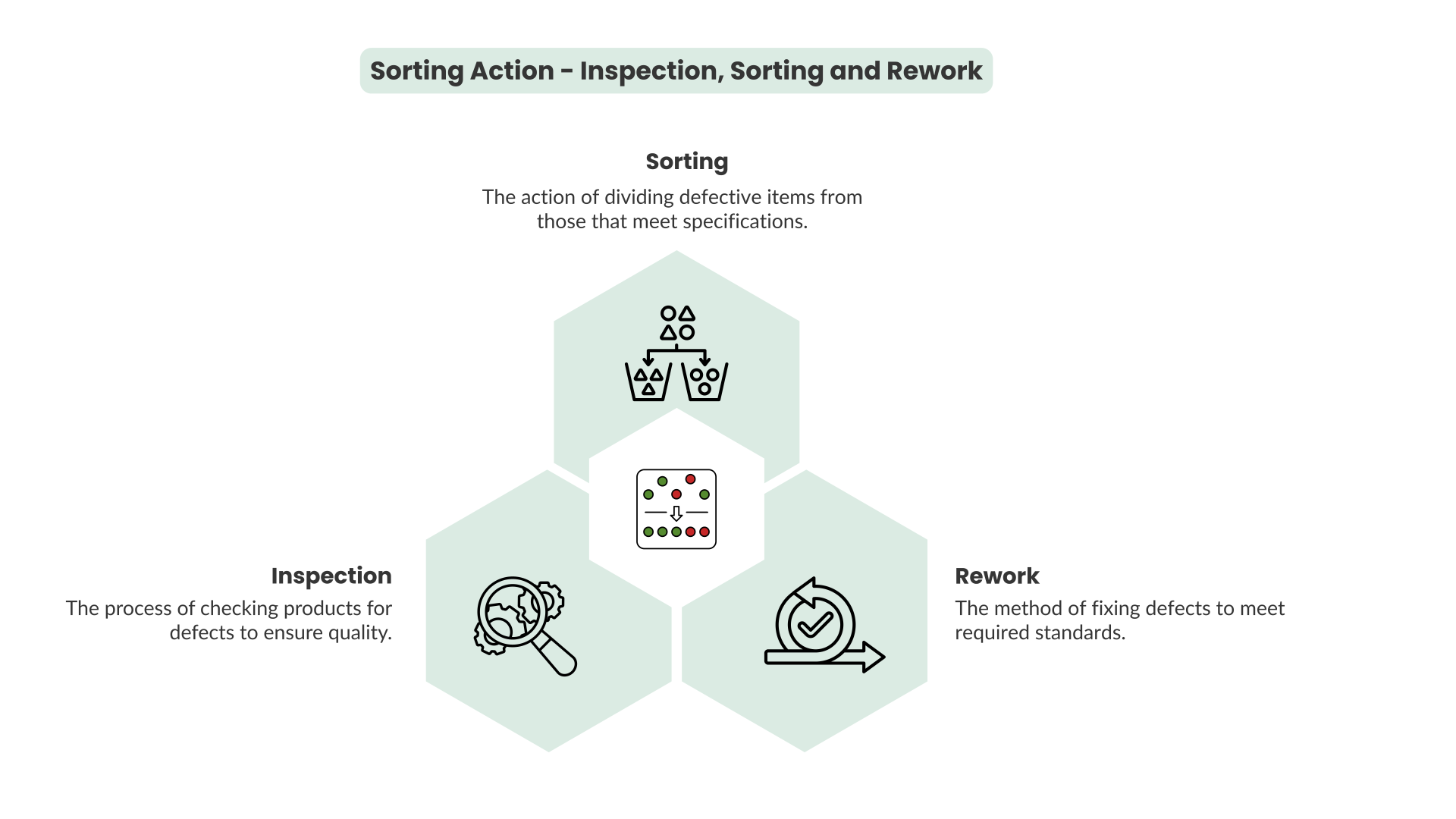
It includes three main actions:
ISR has grown with industrial quality management. Starting from early 1900s quality control methods, ISR gained popularity due to mass production. Quality focus increased in the 1950s with statistical quality control and Total Quality Management (TQM) ideas, which made inspection, sorting, and rework key parts of the process.
Why Use Sorting Actions?
The objective of sorting actions is to ensure that only products meeting the desired quality standards are delivered to customers. Therefore ISR aims to:
- Minimize the number of defective products.
- Enhance product reliability and customer satisfaction.
- Support continuous improvement efforts by identifying defect trends.
When to Use Sorting Actions
Sorting actions are utilized across different industries such as manufacturing, logistics, and services. ISR is mainly applied in manufacturing and production settings, where maintaining high quality in products is essential. They are particularly important in situations where defects or variations in quality can have significant impact, ranging from assembly and logistics disruptions to customer dissatisfaction or compliance issues.
Sorting Action Principles

Prevention
In ISR, the idea of Prevention highlights the need to find defects early in the production process. Catching defects early lowers the chance that faulty products will move on to later stages of production, where fixing them can be harder and more expensive. By spotting problems before they affect the final product, the Prevention principle helps both manufacturers and customers avoid issues related to low quality, such as customer complaints and returns. Prevention aims to foster an environment of proactive quality control using early detection methods, like visual checks, automated inspections, and preliminary testing, to lower risks.

Fast Reaction
As a reactive tool, the Fast Reaction principle emphasizes the need of reacting fast to defects as they arise. This idea is to minimize delays in handling defects so as to prevent their escalation in cost or interruption of the manufacturing process. Once an issue is discovered, a process guarantees that there is an instant response akin to isolating the defective item, contacting relevant teams, and, if at all feasible, initiating rework. This fast reaction reduces the possibility of defects spreading in the manufacturing process. Effective communication, well-defined response protocols, and trained staff members who can rapidly handle quality problems as they develop will help Fast Reaction to keep a smooth operation.

Efficiency
The Efficiency principle in ISR aims to improve inspection, sorting, and rework processes to cut down on waste and costs. By developing a more efficient way to find and fix defects, organizations can save resources like time, labor, and materials used on defective products. Effective ISR processes include strategically placing inspection points, setting clear sorting rules, and refining rework methods to avoid production delays. This principle seeks to integrate quality control seamlessly into the production workflow, balancing thorough defect management with the need to keep production fast and cost-effective.

Clear Work Instructions and Acceptance Criteria
Clear Work Instructions and Acceptance Criteria is a principle that ensures that all tasks related to quality in ISR are guided by clear and standard instructions or criteria for product quality. This principle makes sure that every team member, from operators to inspectors, understands the steps needed to evaluate, sort, and rework products based on quality standards. Clear instructions and criteria help reduce confusion in quality checks and rework, leading to a more uniform application of standards and lowering the chance of personal interpretations. When acceptance criteria are clearly defined, they serve as benchmarks that help everyone tell apart conforming products from non-conforming ones. This principle also improves training and onboarding by providing a source that ensures all staff understand and use the same quality expectations, which strengthens the overall dependability of the ISR process.

Consistency and Uniformity in Application
The Consistency and Uniformity in Application principle highlights that the ISR process must be used the same way throughout all production levels and by all workers involved. Consistency makes sure that the same standards, methods, and actions are used whenever a product is checked, sorted, or reprocessed, no matter who does the work, where it is done or when it is done. This consistent approach lowers changes in quality control, making sure that problems are handled in the same manner across the supply chain.

Automation of Documentation and IT Support
The Automation of Documentation and IT Support idea shows how technology helps improve ISR tasks. By automating documentation, tracking inspections, sorting, and rework happens in real-time, which cuts down on manual record-keeping and lowers human mistakes. Defect information may be promptly documented, sorted, and evaluated with IT assistance, facilitating the quicker identification of issues and patterns. Additionally, by notifying the appropriate parties when issues arise, suggesting rework procedures, or designating items for additional inspections, IT systems may facilitate prompt decision-making. ISR activities function more smoothly when automation and IT are coupled.

Continuous Improvement
Continuous Improvement in ISR means regularly looking at defect data to spot ongoing issues and their root causes. This information is then used to make changes to production or inspection processes for better quality long-term. Each defect found is seen as a chance to improve methods, tools, or skills. For instance, frequent issues of a certain type might point to a design problem, poor materials, or a need for better operator training. Continuous Improvement is often aided by root cause and trend analysis, where patterns are examined, and corrective measures are taken, making it less likely for similar defects to happen again and fostering a culture of quality.
How to Conduct a Sorting Action
1. Define acceptance criteria
When starting a sorting task, it is very important to set acceptance criteria clearly. These criteria are the rules for deciding if items fullfill the specification. They need to be clear without any confusion, and they should be specific, measurable, and match known quality standards. Good acceptance criteria explain what an acceptable product looks like in areas like size, finish, color, or functionality, helping inspectors to make clear decisions. This clarity helps everyone, including inspectors and quality control staff, to understand the standards, which leads to better consistency and accuracy in the sorting process. By having clear criteria, companies can lessen different interpretations, simplify the sorting stage, and improve the reliability of finding defects, which all helps to make the ISR process more effective.
2. Create inspection plan and sort instructions
Making a solid inspection plan is important for doing sorting tasks properly. This plan needs to include details like how to inspect, how many samples to take, how often to check, and where to inspect. A clear plan helps inspectors to know when, where, and how to check for which defects. Additionally sort instructions have to explain how to deal with items based on inspection results. That means which items are acceptable, which ones can be fixed, and what should be thrown away. By giving inspectors clear directions, companies can maintain consistent standards, avoid interrupting work flow, and use resources better for sorting.
3. Sort items
Sorting is grouping assessed items according to specification: scrap, acceptable, or need for rework. This means to verify every item found while sorting and classifying it according to kind and severity of defects. There should be consistent sorting guidelines whereby large structural issues as scrap are marked as reworkable and minor cosmetic flaws as such. This straightforward approach guarantees correct handling of faulty goods, therefore reducing the possibility of their reaching consumers. Good sorting also entails creating a regulated system for managing various categories, such as dedicated places for scrap and rework items, thereby maintaining production flow and preventing mixing of sorted goods.
4. Segregate non-conforming items
When finding items that do not meet the acceptance criteria, it is important to separate them from the ones that are acceptable. This might mean moving non-compliant items away or labeling them for next steps, like fixing or throwing away, so they are not accidentally included in the final product.
5. Rework or discard non-conforming items
Fixing or throwing away defective items is vital for keeping product quality high. Items marked for rework are sent to specialized areas where corrections are made, like replacing parts, smoothing surfaces, or fixing issues. Defective items, which cannot be fixed have to be scrapped or sent back to the supplier. Clear procedures for both rework and disposal, including what can be repaired and what should be thrown out, ensure smooth operations and avoid unnecessary handling of items that cannot be recovered. Making sure reworked items go through a final inspection before being released helps uphold quality standards and confirms they meet the same criteria as original, defect-free products.
6. Record and analyze defects
Recording defect information is an essential part of ISR, as it allows organizations to monitor quality performance, find patterns, and take preventive actions. By noting each defect’s type, location, frequency, and likely cause, quality teams can build a detailed database that shows repeated issues or risky areas. Automated data recording systems are especially useful here because they enable real-time analysis and reporting. This data is crucial for root cause analysis, helping teams find and fix underlying process problems or material issues. Regularly reviewing defect data serves a key role in maintaining product quality.
7. Charge sorting and rework costs
Charging the sorting and rework costs links the expenses of problem fix and waste to the department, the supplier or process that caused the issue. This approach guarantees that every team or department is financially accountable for the generated quality concerns, therefore motivating them to adhere to quality criteria and stop difficulties. Tracing expenses down to their source—that of a particular equipment, material supplier, or production stage—helps to expose process ownership and improve openness. Since every team understands that their activities affect manufacturing costs, this responsibility creates a quality-oriented culture. Moreover, by monitoring these expenses, management may identify and concentrate on areas requiring quality improvement. This reduces defect rates and the financial consequences of quality problems for the company.
How to Combine Sorting- and Rework-Actions with Other Quality Tools
The Sorting Action is a CONTAINMENT tool – it protects customers from defects, but doesn’t fix root causes. To build a complete quality response, combine Sorting with these essential tools:
8D Report
Sorting is D3 (Containment) in the 8D process. “Sorting stops the bleeding while 8D finds and fixes the root cause.” Sorting without 8D = recurring problem. 8D without sorting = customers receive defects during investigation. They’re partners: containment + correction.
Is-Is-Not Analysis
Before sorting, Is-Is-Not sharpens problem definition. “IS: scratches on top surface. IS NOT: scratches on bottom. IS: Parts from Machine 3. IS NOT: Machines 1, 2, 4.” Is-Is-Not narrows the sorting scope. Why sort 10,000 parts when the problem is only 2,000 from one machine?
5-Why Analysis
After sorting reveals the defect pattern, 5-Why finds the root cause. “Sorting shows 80% of defects are contamination. Why? Cleaning wasn’t done. Why? Procedure was unclear. Why?…” Sorting data feeds 5-Why with facts. “We found contamination” becomes “contamination comes from inadequate cleaning procedure.”
Ishikawa Diagram
When defect causes need systematic exploration during or after sorting. “Sorting found 5 defect types – Ishikawa explores why each occurs.” Man, Machine, Material, Method, Measurement, Environment. Ishikawa ensures you don’t miss causes while focused on sorting.
FMEA
FMEA identifies risks; Sorting contains them when they occur. “FMEA predicted this failure mode – now it happened and we’re sorting.” Update FMEA detection scores based on sorting results. If sorting catches defects FMEA said would escape, improve the FMEA.
Control Chart
Control Charts detect when sorting is needed; Sorting validates process recovery. “Control chart showed out-of-control at 10 AM – sort everything produced until 2 PM when we fixed it.” SPC triggers sorting. After correction, SPC confirms stability. Together they form detect → contain → verify.
Pareto Chart
Pareto prioritizes which defect types to focus on during sorting. “Sorting found 6 defect types – Pareto shows 70% are scratches.” Don’t treat all defects equally. Focus sorting resources on the vital few. Pareto turns sorting data into prioritized action.
Check Sheet
Check Sheets structure sorting data collection. “Design a Check Sheet: Part ID, Defect Type, Location, OK/Rework/Scrap, Inspector, Time.” Sorting without structured data is just moving parts around. Check Sheets turn sorting into actionable intelligence.
Cost of Quality (CoQ)
Sorting costs are Internal Failure Costs in CoQ. “Sorting labor: €5,000. Scrap: €12,000. Rework: €8,000. Total internal failure: €25,000.” CoQ makes sorting visible to management. When they see €25,000 sorting cost, prevention investments become attractive.
Red Rabbit Test
Red Rabbit validates that sorting actually catches defects. “We’re sorting for scratches – but are inspectors actually finding them?” Plant known defects in the sorting flow. If Red Rabbit shows 70% detection, your sorting is leaking 30% of defects. Sorting without validation is false confidence.
MSA / Gage R&R
When sorting requires measurements, MSA ensures measurement reliability. “Sorting by dimension – but can inspectors measure accurately enough?” Good sorting with bad measurement = inconsistent results. Validate measurement systems before trusting sorting decisions.
Poka Yoke
When sorting reveals inspection limitations, Poka Yoke removes human error. “Sorting catches 85% of defects – can we prevent them instead of detect them?” If you’re sorting repeatedly for the same defect, design it out. Poka Yoke > Sorting > Hope.
Training Matrix
Sorting results reveal inspector training needs. “Inspector B sorted 30% more parts to rework than Inspector A – same lot.” Sorting performance differences indicate skill gaps. Feed results into training plans for continuous improvement.
Work Instructions / SOP
When sorting criteria are unclear, SOPs need improvement. “Inspectors disagree on borderline parts during sorting – what’s the standard?” Vague instructions = inconsistent sorting. Update SOPs with clear go/no-go criteria, then re-sort if needed.
Supplier Scorecard
Sorting results feed supplier performance metrics. “Supplier X caused 3 sorting actions this quarter – total cost €45,000.” Documented sorting costs strengthen supplier negotiations. “Your quality costs us €45,000” is more powerful than “your quality is bad.”
PDCA Cycle
Sorting fits into PDCA for quality improvement. “Plan: Reduce sorting need by 50%. Do: Implement prevention. Check: Monitor sorting frequency. Act: Standardize or adjust.” Sorting data in Check phase validates if improvements work. Less sorting = better prevention.
5W2H Method
5W2H structures the sorting action planning. “What: Sort for contamination. Who: Quality team + 3 temps. When: Monday-Wednesday. Where: Warehouse A. How: Visual + UV light.” 5W2H prevents sorting chaos. Clear answers before starting = efficient execution.
Benefits of Sorting Actions
Quality Improvement
ISR processes help to improve product quality as they ensure that only products that meet the standards and specifications go to customers. By inspecting and sorting, defective products are found and taken out of production, stopping quality problems from getting worse and ensuring that only working, compliant products get sent to customers. Over time, this focus on quality makes output more consistent and builds customer trust, as they get products that regularly meet their needs and requirements.
Customer Satisfaction Boost
By cutting down the chances of defects in the final product, ISR boosts customer satisfaction. Customers get products that function correctly and meet quality standards, resulting in fewer returns and complaints. The proactive approach of ISR shows the company’s dedication to quality, which can enhance brand loyalty and improve its reputation. Moreover, happy customers are more likely to buy again and recommend the company to others, leading to a positive cycle of customer interaction and long-lasting loyalty.
Waste and Rework Cost Reduction
ISR cuts waste and rework costs by catching defects early in the production phase, lowering the need for extensive rework or throwing away entire products. Because defective items are identified before they reach the further production stages, the ISR process saves resources like materials, labor. Therefore this method is beneficial for both the environment and the company’s finances, as it helps lower waste and costs related to defects. These savings can be reinvested in quality improvement initiatives or passed on to customers through lower prices.
Continuous Improvement
ISR provide helpful insights into processes that can be used to improve production methods and fix underlying quality problems. Each inspection, sorting, and rework record provides a chance to learn, because it offers information on defects, potential root causese, and how efficient the containment works. Quality teams can study the defect patterns and identify specific parts of the production line that might need changes, better training, or new materials. These insights can start a cycle of continuous improvement. This allows companies to enhance processes and elevate quality in a focused, evidence-based way, which ultimately leads to a stronger and more refined production system.
Limitations of Sorting Actions
Resource-Intensive
ISR can be quite ressource-intensiv. It needs labor, time, and money for thorough inspections, sorting, and rework. Cost increase, because skilled worker, special tools, and designating space is needed for inspection and rework. Smaller firms or those with limited budgets may struggle to manage the ISR process due to these expenses. Moreover, time spent on ISR can slow production because resources are pulled from main manufacturing tasks. It is crucial to balance quality needs with the availability of resources to keep ISR processes effective and not strain production budgets.
More Reactive Than Preventive
A main drawback of ISR is that it is reactive, meaning it deals with defects only after they happen. While ISR can effectively catch and fix nonconforming products, it does not prevent the root causes of these defects from reoccurring. This reactive method might create a cycle where the same problems are repeatedly fixed without finding a long-term answer. A preventive strategy, like improving processes or focusing on quality-by-design, could lower defect rates from the start, something ISR alone will not achieve without added preventive steps.
May Impact Production and Logistics
ISR processes can create bottlenecks in production, especially if many items need inspection or rework. Production and logistics processes can be delayed and impact delivery schedules as well as production when a lots of items require sorting or rework. High defect rates can swiftly overwhelm ISR resources, leading to a backlog that prevents from non-defective parts delivered to the production line. Therefore quality teams need to carefully plan ISR tasks and align inspection needs with production requirements. If not managed well, ISR can slow down operations and create inefficiencies throughout the production line.
Limited Effectiveness Without Data Review
ISR may not work well without proper data review, as just inspecting, sorting, and reworking products does not tackle the root causes of defects unless defect data is analyzed. If defect patterns are not assessed, ISR efforts might fall into a routine of fixing symptoms rather than addressing the main issues. Companies can spot trends and make corrective actions that lower defect rates by analyzing data. But without this analytical efforts, ISR might result in quick fixes rather than lasting quality improvements. Consequently, organizations lacking resources or skills in data analysis may find it hard to maximize their ISR efforts.
Sorting Action Best Practices

Optimize Inspection Points and Areas
Placing inspection points and areas wisely in the production line helps catch defects early and lessen quality issues later on. To optimize these points, it is useful to inspect after key stages, like assembly, finishing, or packaging, where mistakes are likely to happen. This approach allows for identifying defects before wasting time or materials on the product. Companies can reduce unnecessary inspections by carefully choosing these points while still ensuring thorough quality checks. Optimized inspection areas lower overall inspection times, maintain production flow, and direct resources to the highest-risk areas of production.

Engage External Quality Teams
Using outside quality service providers can be a smart choice for businesses looking to improve their ISR process without using too many internal resources. These providers have special skills, modern tools, and can handle lots of inspection, sorting, and rework tasks. They usually offer services like on-site inspections, quality checks, or off-site rework. This is helpful during busy times or when many products need checking. Additionally, these providers often use the latest quality control technology, like AI inspection systems and detailed data analysis, providing insights that may not be available within the company. Partnering with an outside quality service can increase flexibility, reduce ISR costs, and improve consistency.

Use Data for Root Cause Analysis
Using defect data for root cause analysis changes ISR from a reactive measure to a preventive approach. By regularly collecting and examining data about defect types, locations, and frequencies, companies can discover recurring problems and their root causes. This process helps to identify parts of production, parts or suppliers that might need adjustments. Data-driven ISR techniques enable teams to develop long-term changes that reduce defect rates, therefore improving the ISR process and lowering the need for significant rework or waste, instead of only addressing problems.

Automate Wherever Possible
Every Parts of the ISR process, that can be automated, will increase speed, accuracy, and consistency in defect discovery. Artificial intelligence (AI) defect detection software, computer vision, and inspection systems are examples of technologies that might help human inspectors. Automation reduces inspection times and eliminates inspector judgment errors, therefore promoting a more consistent quality evaluation. Companies that embrace automation can effectively handle more inspections, streamline sorting, and free employees to concentrate on critical quality improvement projects. Automation therefore helps ISR procedures to be more scalable and able to control bigger production runs without compromising quality.
Sorting Action Example: Pizza Quality
Background
Zero-Defect Pizzaria is committed on premium ingredients to provide consumers with outstanding pizzas. Checking ingredient quality can be difficult and though, especially during hectic hours like weekends and promotions because of frequent deliveries and the demand for fast service.
Therefore Zero-Defect Pizzaria uses an independent quality service provider to check and organize ingredients as business picks up so production can continue without compromising quality. While the pizzeria maintains quick production and delivery, this cooperation helps them guarantee rigorous quality standards.
1. Define Acceptance Criteria
Zero-Pizza sets clear quality specifications for each ingredient, which are shared with the external partner on a regular basis.
These rules center on important traits such freshness, appearance, and expiration dates for every kind of ingredients, including:
- Vegetables: firmness, color, free of bruises or wilting.
- Cheese: Fresh scent, constant texture, and no mold.
- Meats: nice color, freshness, and correct temperature.
- Dough: elasticity, freshness, no strange taste.
This knowledge guarantees that external inspectors use the same quality standards as the internal team of Zero-Defect Pizza.
2. Create Inspection Plan and Sort Instructions
During peak times, the external quality provider manages additional inspection points alongside Zero-Pizza’s regular ones:
Delivery Inspection: When new shipments arrive, external inspectors conduct initial checks on batches of vegetables, meats, and dairy products to identify and remove any spoiled or substandard items immediately.
- Storage Monitoring: The external team helps monitor inventory in storage areas, conducting routine checks to remove any ingredients approaching expiration or showing signs of spoilage.
- Pre-Assembly Check: In real-time, the external provider’s staff inspects ingredients right before they are used, ensuring that no defective items reach the assembly line.
3. Parallel Sorting and Fast Removal of Defective Ingredients
To avoid production delays, Zero-Pizza’s sorting actions are designed to operate in parallel with ongoing kitchen activities:
- The external quality provider takes charge of sorting and removing defective ingredients immediately upon discovery, preventing them from entering the assembly line and ensuring a steady supply of fresh ingredients.
- If a particular batch has multiple defects (e.g., a shipment of tomatoes with noticeable bruising), the external team isolates the entire batch and notifies Zero-Pizza’s procurement team, who can then quickly order replacements while production continues with existing stock.
4. Real-Time Coordination and Communication With Kitchen Team
External inspectors work closely with Zero-Pizza’s kitchen team using a communication system that provides real-time updates on ingredient status. If an ingredient doesn’t meet quality checks, the external team quickly informs kitchen staff so they can switch to backup supplies or temporarily change the menu. This smooth coordination allows for quick handling of quality issues without disrupting production or delivery schedules.
5. Document Defect Data and Provide Supplier Feedback
All quality problems found by the outside provider are carefully recorded, with information on the defect type, batch, and supplier. This information is sent to Zero-Defect-Pizzaria, allowing their management to talk about ongoing quality issues with suppliers and arrange for replacements or credits when needed. By working with the external team on a defect log, Zero-Defect Pizzaria can use data to guide decisions for better ingredient sourcing and avoid future issues.
6. Continuous Improvement and Supplier Accountability
With help from outside quality provider, Zero-Defect Pizza learns more about ingredient quality. If one supplier often gives bad ingredients during busy times, the data on defects can help decide whether to change orders or look for new suppliers. This partnership improves quality control and makes suppliers more responsible, aiding Zero-Pizza’s goal for perfect quality over time.
7. Charge Sorting and Rework Costs
Zero-Defect Pizza charges the incurrent costs to the causing supplier.
Summary: Pizza Process Flow
FAQ Sorting Action
What is Inspection, Sorting, and Rework (ISR)?
Inspection, Sorting, and Rework (ISR) is a method used for quality control that focuses on finding, classifying, and fixing defects in products or processes.
It includes three main actions:
Inspection: Checking products for defects.
Sorting: Dividing defective items from those which meet specifications.
Rework: Fixing defects to meet required standards.
ISR has grown with industrial quality management. Starting from early 1900s quality control methods, ISR gained popularity due to mass production. Quality focus increased in the 1950s with statistical quality control and Total Quality Management (TQM) ideas, which made inspection, sorting, and rework key parts of the process.
When is Inspection, Sorting, and Rework (ISR) used?
Sorting actions are utilized across different industries such as manufacturing, logistics, and services. ISR is mainly applied in manufacturing and production settings, where maintaining high quality in products is essential. They are particularly important in situations where defects or variations in quality can have significant impact, ranging from assembly and logistics disruptions to customer dissatisfaction or compliance issues.
Why is Inspection, Sorting, and Rework (ISR) used?
The objective of sorting actions is to ensure that only products meeting the desired quality standards are delivered to customers. Therefore, ISR aims to:
Minimize the number of defective products.
Enhance product reliability and customer satisfaction.
Support continuous improvement efforts by identifying defect trends.
What are the principles of Inspection, Sorting, and Rework (ISR)?
Prevention: Identifying defects early in the process to reduce costs and prevent faulty products from moving forward.
Fast Reaction: Quickly addressing quality issues to prevent production slowdowns.
Efficiency: Streamlining ISR processes to minimize waste and optimize resources.
Clear Work Instructions & Acceptance Criteria: Ensuring all team members follow standardized inspection, sorting, and rework protocols.
Consistency & Uniformity in Application: Applying ISR methods uniformly across all production levels to maintain quality control.
Automation of Documentation & IT Support: Using technology to track, document, and analyze defects efficiently.
Continuous Improvement: Learning from defect data to enhance processes and prevent recurring issues.
How is Inspection, Sorting, and Rework (ISR) performed?
Define Acceptance Criteria – Establish clear quality benchmarks.
Make Inspection Plan and Sort Instructions – Set up guidelines for defect identification and sorting.
Sort Items – Classify items as acceptable, reworkable, or scrap.
Segregate Non-Conforming Items – Physically separate defective items from conforming ones.
Rework or Discard Non-Conforming Items – Fix or dispose of defective products based on feasibility.
Record and Analyze Defects – Document and review defect trends for quality improvements.
Charge Sorting Costs – Assign cost accountability to improve quality ownership.
What are the benefits of Inspection, Sorting, and Rework (ISR)?
Quality Improvement – Ensures only defect-free products reach customers.
Customer Satisfaction Boost – Enhances trust and reliability in products.
Waste and Rework Cost Reduction – Minimizes financial losses due to defects.
Continuous Improvement – Uses defect data for long-term quality enhancement.
What are the limitations of Inspection, Sorting, and Rework (ISR)?
Resource-Intensive – Requires labor, tools, and dedicated space for inspections and rework.
More Reactive than Preventive – Addresses defects after they occur rather than preventing them.
May Impact Production and Logistics – Sorting and rework can slow down manufacturing schedules.
Limited Effectiveness Without Data Review – Without proper analysis, recurring defects may not be addressed efficiently.
What are best practices for Inspection, Sorting, and Rework (ISR)?
Automate Wherever Possible – Use AI and vision-based defect detection for efficiency.
Optimize Inspection Points and Areas – Strategically place inspections at critical production stages.
Engage External Quality Teams – Leverage third-party expertise to enhance quality control.
Use Data for Root Cause Analysis – Analyze trends to shift from reactive to preventive quality management.