What Is a Quality Alert?
Just here for the template? Download the Quality Alert template ↓
A Quality Alert is a formal notification that informs affected teams about a quality problem the moment it is detected. It triggers immediate containment—stopping defective parts, quarantining suspect inventory, and alerting the right people—so a single defect does not become a customer complaint, a recall, or a line stop.
Quality Alert Quick Guide
This guide explains what Quality Alerts are in manufacturing and quality management, when to issue one, and how to write an alert that actually stops defects from spreading – with real examples from five industries and a free template.
💡 Find real-world examples below.
When a defect or customer complaint hits, the Quality Alert is the fastest formal channel a company
has: it puts the problem description, the containment actions, and the responsible people on one
page – within hours, not days.
Why Use a Quality Alert?
A Quality Alert has one job: limit the damage. By notifying the right people immediately, it shortens
the window between defect detection and containment – the window in which defective products
keep reaching customers.
The result is fewer escaped defects, faster complaint resolution, and a supplier reputation that survives the occasional bad day.
When to Use a Quality Alert
Issue a Quality Alert whenever a problem threatens product quality, safety, or customer satisfaction
and immediate action is required. Typical triggers:
Incoming Inspection Failures
When incoming parts or materials fail inspection, a Quality Alert immediately notifies production, warehouse, and purchasing. Sorting Actions prevent defective materials from entering the production process and documents the issue for supplier communication.
In-Process Defects
When operators or automated systems detect defects during production, a Quality Alert triggers immediate containment. The alert ensures affected work-in-progress is quarantined and prevents further defective output until the root cause is addressed.
Customer Complaints
When a customer reports a quality issue, a Quality Alert ensures rapid internal response. It documents the complaint using 5W2H, triggers inspection of remaining inventory, and initiates containment actions to prevent further affected products from shipping.
Supplier Quality issues
When quality issues are traced back to a supplier, a Quality Alert formalizes the problem documentation. It provides the supplier with clear 5W2H data, tracks containment across the supply chain, and creates a record for supplier performance evaluation.
Safety or Compliance Issues
When a potential safety hazard or regulatory non-compliance is discovered, a Quality Alert ensures immediate escalation. These high-priority alerts often require production stops, product recalls, and documentation for regulatory authorities like FDA or IATF auditors.
Quality Alert Principles
The major principles for effective quality alerts are:

Swift Communication
Create the alert within hours of detection, not days. Every hour of delay widens the containment scope: more parts produced, more shipments released, more customers exposed. A fast, imperfect alert beats a polished one that arrives after the defective batch has left the dock.

Personalized Distribution
Send the alert only to the teams that can act on it—production, quality, purchasing, and the affected supplier. Copying the whole company dilutes responsibility and trains people to ignore alerts. Targeted distribution keeps ownership clear and response times short.

Clear Instructions
State exactly what recipients must do: which parts to quarantine, which orders to hold, which inspection to run, and by when. Vague guidance produces vague results. A good Quality Alert reads like a work instruction, not a memo.
How to Create a Quality Alert
1. Log complaint
Record every complaint formally the moment it arrives: what happened, which product and batch,
customer contact details, and supporting evidence such as photos or measurement data.
Complete documentation speeds up the investigation and builds the historical record you will need for trend analysis and audits.
2. Generate quality alert
Summarize the problem on one page using the 5W2H structure: what happened, where, when, who detected it, why it matters, how it was detected, and how many parts are affected.
Add a severity rating. This document is the formal starting signal for the response.
3. Notify affected groups
Distribute the alert immediately to the teams that must contain and fix the problem – and only to
them.
For critical alerts, confirm receipt: an alert that sits unread in an inbox contains nothing.
4. Create action plan
The responsible teams define containment and corrective actions, each with a clear owner and
deadline. For serious or recurring problems, link the alert to a root cause analysis such as a 5-Why
Analysis or a full 8D-Report.
5. Track progress
Follow up on every action until the problem is verifiably resolved: containment confirmed, root
cause fixed, customer informed. Close the alert with a short summary of what was done—this record feeds your FMEA updates and lessons learned.
Quality Alert – Real-World Examples
1. Pizza Production
Dough Pre-Mix
Professional Quality Alert template example from the food industry demonstrating how to document product defects, conduct 5W2H problem analysis, and track immediate containment actions.
💡 Want to create your own? Contact me for the free template.
2. Automotive / Manufacturing
Brake Pad Assembly
Automotive Quality Alert template example showing how to document critical safety defects, track supplier quality issues, and manage containment actions according to IATF 16949 standards.
💡 Want to create your own? Contact me for the free template.
3. Pharmaceutical Industry
PET Bottle Cap
Pharmaceutical Quality Alert template example demonstrating GMP-compliant defect documentation, FDA compliance tracking, and systematic containment actions for packaging defects.
💡 Want to create your own? Contact me for the free template.
4. Service Industry
Customer Onboarding
Service industry Quality Alert template example showing how to document process failures, track customer satisfaction impact, and implement corrective actions for service quality issues.
💡 Want to create your own? Contact me for the free template.
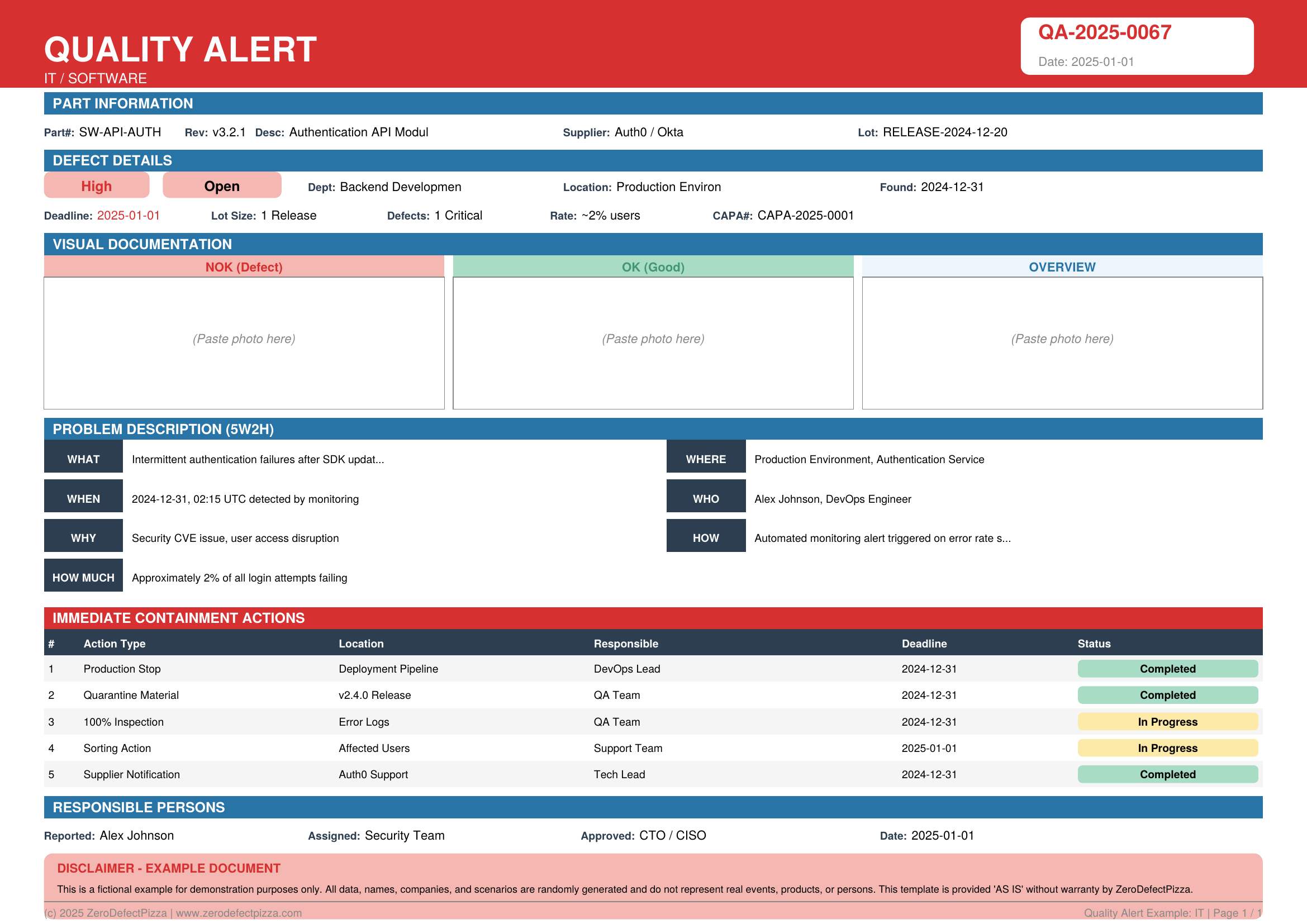
5. IT/Software Industry
API Authentication
IT/Software Quality Alert template example demonstrating how to document critical system failures, track security incidents, and manage deployment rollback containment actions.
💡 Want to create your own? Contact me for the free template.
How to Combine Quality Alerts with Other Quality Tools
5W2H Method
Quality Alerts use 5W2H as their core documentation framework. The structured questions ensure no critical information is missed: What happened? Where? When? Who found it? Why does it matter? How was it detected? How much is affected? This creates a complete problem picture for all stakeholders.
Is-Is-Not Analysis
After the initial Quality Alert captures what happened, Is-Is-Not Analysis helps narrow down the root cause. By comparing where the problem occurs versus where it doesn’t, teams identify patterns that point to specific causes – making subsequent investigations more focused and efficient.
8D Report
Quality Alerts often trigger 8D investigations, especially for customer complaints or recurring issues. The alert provides the initial D1-D2 documentation (team formation and problem description), while the 8D process drives through root cause analysis, corrective actions, and prevention of recurrence.
Ishikawa Diagram
When the Quality Alert identifies a complex problem with multiple potential causes, an Ishikawa (Fishbone) Diagram helps visualize all possibilities. The diagram organizes potential causes into categories (Man, Machine, Material, Method, Measurement, Environment), ensuring thorough root cause investigation.
Action Management
Every Quality Alert generates containment actions that need tracking. Action Management ensures each task has a clear owner, deadline, and status. Integration between Quality Alerts and Action Management prevents actions from falling through the cracks and provides visibility into resolution progress.
Sorting Action
Quality Alerts almost always trigger Sorting Actions as immediate containment. Defect detected → identify suspect inventory → segregate and inspect → release only conforming product. The Sorting Action documents inspection scope, defect rates, and ensures only good parts reach the customer. Alert without Sorting Action = incomplete containment.
5-Why Analysis
After the Quality Alert captures the problem, 5-Why Analysis drills down to root cause. Symptom → Why? → Deeper cause → Why? → Root cause. This simple technique complements Ishikawa: Ishikawa → brainstorm all possible causes; 5-Why → verify the actual cause chain. Quick analysis for urgent alerts where full 8D investigation isn’t yet started.
FMEA (Failure Mode and Effects Analysis)
Quality Alerts provide valuable input for FMEA updates. Alert issued → root cause found → FMEA update required. Every alert represents a failure mode that actually occurred: Occurrence rating → increase if failure happened despite controls; Detection rating → evaluate if controls need improvement. Reactive alert → proactive prevention through FMEA feedback loop.
Poka Yoke (Error-Proofing)
When root cause reveals human error or process gaps, Poka Yoke provides the permanent solution. Quality Alert → identifies WHERE errors occur; Poka Yoke → ensures errors CAN’T occur again. Root cause = operator mistake → design mistake-proofing device; Root cause = wrong part → implement physical differentiation. Prevention beats detection → well-designed Poka Yoke eliminates future alerts on same issue.
Control Chart (SPC)
Control Charts and Quality Alerts work bidirectionally. Detection direction: SPC signal (point outside limits, trend, pattern) → triggers Quality Alert → containment before customer impact. Verification direction: Corrective action implemented → Control Chart confirms process back in control → statistical evidence for alert closure. No SPC verification → risk of premature sign-off.
CAPA Process
While Quality Alerts focus on immediate containment, CAPA addresses long-term prevention. After containment actions stop the bleeding, CAPA investigates the root cause and implements permanent corrective and preventive measures. The Quality Alert becomes the initiating document for the CAPA record.
Benefits of Quality Alerts
Speed
An alert issued within hours of a complaint means containment starts while the defect population is still small. The difference between a same-day alert and a next-week email is often the difference between sorting one pallet and recalling a month of production.
Customer Trust
Customers judge suppliers less by whether a defect occurs than by how fast and transparently it is handled. A documented, rapid alert process is something automotive and pharma auditors explicitly look for.
Prevention
Every alert is a recorded failure mode. Analyzed over time, alerts reveal recurring weak points in processes and suppliers, feeding your FMEA updates and continuous improvement – so the same problem stops coming back.
Limitations of Quality Alerts
Alert Fatigue
If every minor issue triggers an alert, people stop reading them. Reserve Quality Alerts for problems that genuinely threaten quality, safety, or delivery, and handle the rest through your normal deviation process.
Containment is not a cure
An alert stops the bleeding; it does not explain the wound. Without a
follow-up root cause analysis – 5-Why, Ishikawa, or a full 8D-Report – the same alert will resurface.
Treat the alert as the first document in the chain, not the last.
Quality Alert Best Practices
Best practices for Quality Alerts include:

Focus on Urgency
Use Quality Alerts only for issues that require immediate action. Not every complaint deserves an alert—reserving the tool for serious cases keeps its signal value high and directs resources to the problems that actually endanger customers.

Data Analysis
Review your alerts quarterly: which products, processes, and suppliers generate them, and which causes repeat. Recurring alerts on the same failure mode are a direct work order for your prevention efforts—FMEA updates, Poka Yoke solutions, and supplier development.
From the Field
In more than ten years of supplier quality, the most common Quality Alert failure I have seen is not a missing form—it is distribution. The alert gets written, approved, and filed, but never reaches the night shift that keeps producing the defect.
Quality Alert Example: Pizza Delivery
Description of Issue:
Several customers reported that their large Margherita pizzas arrived undercooked in the center, resulting in poor texture and taste. This alert requires immediate containment to protect our promise of a perfect pizza in every box.
Date: [Insert Date]
Alert Level: Critical
Alert Type: Zero-Defect Quality Alert
Product: Margherita Pizza (Large Size)
Departments Notified: Kitchen Staff, Quality Control, Procurement, Customer Service
Action Management Skills Breakdown Step by Step:
1. Issue Summary
Complaint Source: Pizza Delivery
Complaint ID: [Insert Complaint ID]
Description of Issue:
Several customers say the big Margherita pizzas they got were not cooked enough in the center, which made the texture and taste bad. This alert about defects needs quick action to stop more problems and keep our promise to deliver perfect pizzas every time.
Impact:
- Higher chance of unhappy customers and bad reviews.
- Potential drop in returning customers.
- Immediate threat to the restaurant’s quality reputation.
2. Immediate Action Required
Goal:
Maintain zero-defect quality by identifying, containing, and resolving the issue with the undercooked Margherita pizzas.
Primary Actions to Take:
1. Hold Preparation and Distribution of Affected Product:
- Temporarily pause orders for large Margherita pizzas while the issue is investigated.
- Redirect customers to alternative pizza sizes or types as needed.
2. Inspection and Testing:
- Kitchen staff are to inspect the oven settings, particularly for large pizzas, ensuring temperature and cooking times meet established standards.
- Conduct test bakes of the large Margherita pizzas to confirm cooking consistency.
3. Root Cause Analysis:
- Investigate potential causes, such as oven calibration, dough thickness variations, or cheese distribution.
- Perform a 5 Whys analysis to identify the exact source of undercooking.
3. Corrective Action Plan
- Responsible Teams: Kitchen Staff, Quality Control, Equipment Maintenance
- Timeline: Immediate adjustments within 24 hours and a thorough analysis within 48 hours.
- Action Plan:
- Change oven settings or cooking ways based on test outcomes.
- Re-educate staff on how to prepare dough and put together pizza if problems are found.
- Share results and fixes with all related teams to guarantee uniform results in the future.
4. Follow-Up and Monitoring
- Hourly Monitoring:
- Quality Control to oversee baking consistency for all large pizzas over the next 48 hours.
- Customer Service to monitor incoming feedback for any further reports of undercooking.
- Completion Report:
- A final report will be put together in one week. It will include main cause findings, actions taken to fix issues, and any changes to procedures to keep the zero-defect standard.
5. Preventive Action
- Oven Calibration Schedule:
- Ensure ovens are calibrated monthly to maintain consistent baking performance.
- Staff Training:
- Reinforce training on pizza assembly and cooking techniques to prevent future inconsistencies.
- Establish a checklist for staff to verify correct dough thickness and topping distribution on all large pizzas.
Free Quality Alert template
Excel template + 5 filled examples
- Problem description with photo slot
- Affected scope: batch, line, period
- Containment: what stops now
- Owner and deadline
- Distribution list and closure criteria
Included in the free ZDP Quality Toolbox. See all 29 methods →
FAQ Quality Alert
What is a Quality Alert?
A Quality Alert is a formal notification used by companies to communicate a quality problem to the
affected teams the moment it is detected. It serves as a rapid-response tool: containing the defect,
informing the right people, and starting the corrective process before more customers are affected.
When is a Quality Alerts be used?
Quality Alerts notify relevant teams when a customer reports a product or service quality issue. This ensures that corrective actions are initiated quickly, preventing further issues and improving product quality before more customers are affected.
Why is a Quality Alert used?
The primary objective of a Quality Alert is to minimize the impact of customer complaints by quickly informing the necessary staff so they can take immediate action. It aims to:
Improve customer satisfaction.
Maintain the company’s reputation.
Ensure swift corrective and preventive action management (CAPA).
Reduce risks and prevent recurrence.
Support continuous quality improvement.
What is the main objective of Quality Alerts?
The primary objective of Quality Alerts is to ensure a rapid response to customer complaints, thereby enhancing customer satisfaction and maintaining the organization’s reputation.
Where did the concept of Quality Alerts originate?
Quality Alerts have their roots in Total Quality Management (TQM) and Six Sigma methodologies and gained prominence in the 20th century as organizations recognized the need for swift responses to customer concerns.
What are the key principles of Quality Alerts?
Swift Communication – Quality Alerts should be created and distributed immediately after a complaint is received to prevent escalation.
Personalized Distribution – Alerts should only be sent to the departments and teams responsible for resolving the issue, avoiding unnecessary involvement of unrelated personnel.
Clear Instructions – The alert must provide precise guidance on the required actions to resolve the problem efficiently and avoid confusion or delays.
What are the steps involved in submitting Quality Alerts?
Receipt of Complaint – Customer complaints are officially recorded, including relevant details and documentation.
Quality Alert Generation – A Quality Alert is created, summarizing the issue, severity, and potential impact.
Notification – The appropriate teams and stakeholders are informed immediately so they can initiate action.
Action Plan Development – A corrective and preventive action plan is created, assigning responsibilities and setting timelines.
Follow-Up – Progress is monitored, and issue resolution is tracked to ensure effective closure.
What are the benefits of using Quality Alerts?
The benefits include:
- Rapid response to customer complaints
- Enhanced customer satisfaction
- Prevention of recurring issues
What limitations should be considered when using Quality Alerts?
Overuse – Excessive alerts may lead to employees ignoring them, reducing their effectiveness.
Lack of Depth – If not properly documented or followed up, alerts may fail to provide long-term solutions.
What are some best practices for implementing Quality Alerts?
Focus on Urgency – Use Quality Alerts only for serious complaints that require immediate action.
Data Analysis – Regularly analyze alert trends to identify and address recurring issues.
Clear and Concise Communication – Ensure Quality Alerts are easy to understand and contain actionable instructions.
What is an example of how a Quality Alert works in practice?
A manufacturing company that receives a customer complaint about a defective product batch. A Quality Alert is issued, notifying the production and quality control teams. Production is halted for that batch, an investigation is conducted, and corrective actions are taken promptly to prevent further defects, ensuring customer satisfaction and preserving the company’s reputation.